The American Flag Is Carried Into Battle for the First Time Art

Raising the Flag on Iwo Jima is an iconic photograph of six Us Marines raising the U.South. flag atop Mount Suribachi during the Battle of Iwo Jima in the final stages of the Pacific War. The photograph, taken by Joe Rosenthal of the Associated Press on Feb 23, 1945, was get-go published in Dominicus newspapers two days later and reprinted in thousands of publications. Information technology was the simply photo to win the Pulitzer Prize for Photography in the aforementioned yr as its publication, and was later used for the construction of the Marine Corps War Memorial in 1954, which was defended to honor all Marines who died in service since 1775. The memorial, sculpted by Felix de Weldon, is located in Arlington Ridge Park,[1] almost the Ord-Weitzel Gate to Arlington National Cemetery and the Netherlands Carillon. The photograph has come to be regarded in the U.s. as one of the most significant and recognizable images of Globe State of war II.
The flag raising occurred in the early on afternoon, subsequently the mountaintop was captured and a smaller flag was raised on superlative that forenoon. Three of the vi Marines in the photo—Sergeant Michael Strank, Corporal Harlon Block, and Private First Form Franklin Sousley—were killed in action during the boxing; Block was identified as Sergeant Hank Hansen until January 1947 and Sousley was identified as PhM2c. John Bradley, USN, until June 2016.[2] The other 3 Marines in the photograph were Corporals (then Privates First Course) Ira Hayes, Harold Schultz, and Harold Keller; Schultz was identified as Sousley until June 2016[2] and Keller was identified as Rene Gagnon until October 2019.[3] All of the men served in the 5th Marine Segmentation on Iwo Jima.
The Associated Printing has relinquished its copyright to the photograph, placing it in the public domain.[4]
Background [edit]

On February nineteen, 1945, the United States invaded Iwo Jima as office of its island-hopping strategy to defeat Japan. Iwo Jima originally was non a target, but the relatively quick fall of the Philippines left the Americans with a longer-than-expected lull prior to the planned invasion of Okinawa. Iwo Jima is located halfway between Japan and the Mariana Islands, where American long-range bombers were based, and was used past the Japanese as an early on warning station, radioing warnings of incoming American bombers to the Japanese homeland. The Americans, after capturing the island, weakened the Japanese early on warning arrangement, and used it as an emergency landing strip for damaged bombers.[v]
Iwo Jima is a volcanic island, shaped like a trapezoid. From the air, information technology looks like a "lopsided, black porkchop".[6] The isle was heavily fortified, and the invading Marines suffered loftier casualties. Politically, the isle is function of the prefecture of Tokyo. It would be the outset Japanese homeland soil to be captured by the Americans, and it was a matter of award for the Japanese to prevent its capture.[7]
The island is dominated by Mount Suribachi, a 546-pes (166 m) dormant volcanic cone at the southern tip of the island. Tactically, the pinnacle of Suribachi was ane of the most important locations on the island. From that vantage signal, the Japanese defenders were able to spot artillery accurately onto the Americans—especially the landing beaches. The Japanese fought most of the battle from underground bunkers and pillboxes. It was mutual for Marines to disable a pillbox using grenades or flamethrowers, only to come nether renewed fire from information technology a few minutes later on, after replacement Japanese infantry arrived into the pillbox through a tunnel. The American endeavor concentrated on isolating and capturing Suribachi first, a goal that was accomplished on February 23, four days later on the battle began. Despite capturing Suribachi, the battle continued to rage for many days, and the island would not exist declared "secure" until 31 days later, on March 26.[8]
Two flag-raisings [edit]
There were two American flags raised on pinnacle of Mount Suribachi, on February 23, 1945. The photo Rosenthal took was actually of the second flag-raising, in which a larger replacement flag was raised by different Marines than those who raised the get-go flag.[ix]
Raising the first flag [edit]
A U.S. flag was outset raised atop Mountain Suribachi soon after the mountaintop was captured at around 10:xx a.1000. on February 23, 1945.[ten]

Raising the First Flag on Iwo Jima by SSgt. Louis R. Lowery, USMC, is the nigh widely circulated photograph of the get-go flag flown on Mt. Suribachi. [ citation needed ]
Left to correct: 1st Lt. Harold Schrier[eleven] (kneeling behind radioman's legs), Pfc. Raymond Jacobs (radioman reassigned from F Company), Sgt. Henry "Hank" Hansen wearing cap, holding flagstaff with left manus), Platoon Sgt. Ernest "Boots" Thomas (seated), Pvt. Phil Ward (holding lower flagstaff with his correct hand), PhM2c. John Bradley, USN (holding flagstaff with both hands, his right paw in a higher place Ward's right hand and his left paw below.), Pfc. James Michels (holding M1 Carbine), and Cpl. Charles Westward. Lindberg (continuing above Michels).
Lieutenant Colonel Chandler W. Johnson, commander of the 2nd Battalion, 28th Marine Regiment, 5th Marine Sectionalization, ordered Marine Captain Dave Severance, commander of Easy Visitor, 2nd Battalion, 28th Marines, to ship a platoon to seize and occupy the crest of Mount Suribachi.[12] First Lieutenant Harold G. Schrier, executive officeholder of Easy Company, who had replaced the wounded 3rd Platoon commander, John Keith Wells,[13] volunteered to atomic number 82 a 40-human being combat patrol upwards the mountain. Lieutenant Colonel Johnson (or 1st Lieutenant George Chiliad. Wells, the battalion adjutant, whose chore it was to bear the flag) had taken the 54-past-28-inch (137 cm × 71 cm) flag from the battalion's ship ship, USSMissoula, and handed the flag to Schrier.[14] [15] Johnson said to Schrier, "If yous get to the top, put it upwards." Schrier assembled the patrol at 8 a.thou. to begin the climb upwards the mountain.
Despite the large numbers of Japanese troops in the vicinity, Schrier's patrol made it to the rim of the crater at well-nigh 10:xv a.m., having come under little or no enemy fire, equally the Japanese were being bombarded at the time.[16] The flag was fastened by Schrier and two Marines to a Japanese iron water pipe constitute on pinnacle, and the flagstaff was raised and planted past Schrier, assisted past Platoon Sergeant Ernest Thomas and Sergeant Oliver Hansen (the platoon guide) at about 10:30 a.m.[11] (On February 25, during a CBS press interview aboard the flagship USSEldorado about the flag-raising, Thomas stated that he, Schrier, and Hansen had actually raised the flag.)[17] The raising of the national colors immediately caused a loud auspicious reaction from the Marines, sailors, and coast guardsmen on the embankment beneath and from the men on the ships about the beach. The loud noise made by the servicemen and blasts of the ship horns alerted the Japanese, who up to this point had stayed in their cavern bunkers. Schrier and his men near the flagstaff so came under fire from Japanese troops, simply the Marines speedily eliminated the threat.[18] Schrier was later awarded the Navy Cross for volunteering to have the patrol up Mountain Suribachi and raising the American flag, and a Silver Star Medal for a heroic activity in March while in command of D Company, 2/28 Marines on Iwo Jima.
Photographs of the first flag flown on Mountain Suribachi were taken by Staff Sergeant Louis R. Lowery of Leatherneck magazine, who accompanied the patrol up the mountain, and other photographers afterwards.[19] [20] Others involved with the outset flag-raising include Corporal Charles West. Lindberg (who as well helped raise the flag),[21] [ page needed ] [ meliorate source needed ] Privates First Class James Michels, Harold Schultz, Raymond Jacobs (F Visitor radioman), Private Phil Ward, and Navy corpsman John Bradley.[22] This flag was besides small, nevertheless, to exist easily seen from the northern side of Mount Suribachi, where heavy fighting would get on for several more than days.
The Secretarial assistant of the Navy, James Forrestal, had decided the previous night that he wanted to get ashore and witness the terminal stage of the fight for the mountain. At present, under a stern commitment to take orders from Howlin' Mad Smith, the secretarial assistant was churning ashore in the company of the blunt, earthy full general. Their boat touched the beach simply afterwards the flag went up, and the mood among the loftier command turned jubilant. Gazing up, at the reddish, white, and bluish speck, Forrestal remarked to Smith: "Holland, the raising of that flag on Suribachi means a Marine Corps for the side by side v hundred years".[23] [24]
Forrestal was and then taken with fervor of the moment that he decided he wanted the Second Battalion's flag flying on Mt. Suribachi as a souvenir. The news of this wish did not sit well with 2d Battalion Commander Chandler Johnson, whose temperament was as every bit fiery as Howlin Mad'south. "To hell with that!" the colonel spat when the message reached him. The flag belonged to the battalion, as far every bit Johnson was concerned. He decided to secure it as before long as possible, and dispatched his banana operations officer, Lieutenant Ted Tuttle, to the beach to obtain a replacement flag. As an afterthought, Johnson chosen after Tuttle: "And make information technology a bigger one."[25]
—James Bradley, Flags of Our Fathers
Raising the second flag [edit]
The photograph taken by Rosenthal was the second flag-raising on top of Mountain Suribachi, on February 23, 1945.[26]
Sgt. Genaust's movie shot of the second flag-raising, excerpted from the 1945 Carriers Hit Tokyo newsreel
On orders from Colonel Chandler Johnson—passed on by Piece of cake Company'due south commander, Captain Dave Severance—Sergeant Michael Strank, one of 2d Platoon's team leaders, was to have 3 members of his rifle team (Corporal Harlon H. Cake and Privates First Class Franklin R. Sousley and Ira H. Hayes) and climb upwardly Mount Suribachi to raise a replacement flag on acme; the three took supplies or laid telephone wire on the style to the height. Severance also dispatched Private Outset Class Rene A. Gagnon, the battalion runner (messenger) for Easy Company, to the command post for fresh SCR-300 walkie-talkie batteries to be taken to the pinnacle.[27]
Meanwhile, Lieutenant Albert Theodore Tuttle[25] under Johnson'southward orders, had found a large (96-by-56–inch) flag in nearby Tank Landing Ship USS LST-779. He fabricated his way dorsum to the command mail service and gave information technology to Johnson. Johnson, in turn, gave it to Rene Gagnon, with orders to take it upward to Schrier on Mount Suribachi and raise it.[28] The official Marine Corps history of the event is that Tuttle received the flag from Navy Ensign Alan Woods of USS LST-779, who in turn had received the flag from a supply depot in Pearl Harbor.[29] [thirty] [31] Severance had confirmed that the second larger flag was in fact provided by Alan Forest fifty-fifty though Wood could non recognize any of the pictures of the second flag's raisers as Gagnon.[32] The flag was sewn past Mabel Sauvageau, a worker at the "flag loft" of the Mare Isle Naval Shipyard.[33]

Offset Lieutenant George Greeley Wells, who had been the 2nd Battalion, 28th Marines adjutant officially in charge of the 2 American flags flown on Mount Suribachi, stated in The New York Times in 1991 that Lieutenant Colonel Johnson ordered Wells to get the 2nd flag, and that Wells sent Rene Gagnon, his battalion runner, to the ships on shore for the flag. Wells said that Gagnon returned with a flag and gave it to him, and that Gagnon took this flag up Mt. Suribachi with a message for Schrier to enhance it and transport the other flag downwardly with Gagnon. Wells stated that he received the get-go flag back from Gagnon and secured it at the Marine headquarters control postal service. Wells also stated that he had handed the starting time flag to Lieutenant Schrier to take up Mount Suribachi.[xiv]
The Coast Guard Historian'southward Office recognizes the claims made past former U.S. Declension Guardsman Quartermaster Robert Resnick, who served aboard the USSDuval County at Iwo Jima. "Before he died in Nov 2004, Resnick said Gagnon came aboard LST-758[34] the morning of Feb 23 looking for a flag.[35] Resnick said he grabbed a flag from a bunting box and asked permission from his transport's commanding officeholder Lt. Felix Molenda to donate information technology.[36] Resnick kept quiet about his participation until 2001."[37] [38]
Rosenthal's photograph [edit]
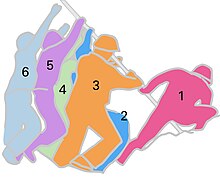
Gagnon, Strank, and Strank'south three Marines reached the meridian of the mountain around noon without existence fired upon. Rosenthal, along with Marine photographers Sergeant Bill Genaust (who was killed in activeness after the flag-raising) and Private First Form Bob Campbell[39] were climbing Suribachi at this time. On the way upward, the trio met Lowery, who had photographed the first flag-raising, coming down. They considered turning around, but Lowery told them that the summit was an excellent vantage point from which to take photographs.[40] The iii photographers reached the summit equally the Marines were attaching the flag to an quondam Japanese water piping.
Rosenthal put his Speed Graphic camera on the ground (set to ane/400 sec shutter speed, with the f-stop between viii and eleven and Agfa film[41] [42]) and so he could pile rocks to stand on for a better vantage point. In doing so, he nearly missed the shot. The Marines began raising the flag. Realizing he was nigh to miss the activity, Rosenthal apace swung his photographic camera upwardly and snapped the photograph without using the viewfinder.[43] 10 years after the flag-raising, Rosenthal wrote:
Out of the corner of my eye, I had seen the men commencement the flag up. I swung my camera and shot the scene. That is how the picture was taken, and when yous accept a picture like that, you lot don't come away proverb you got a smashing shot. You don't know.[42]
Sergeant Genaust, who was standing about shoulder-to-shoulder with Rosenthal almost three feet away,[42] was shooting move-picture show film during the second flag-raising. His flick captures the second consequence at an nigh-identical angle to Rosenthal's shot. Of the six flag-raisers in the picture—Ira Hayes, Harold Schultz (identified in June 2016), Michael Strank, Franklin Sousley, Harold Keller (identified in 2019), and Harlon Block—only Hayes, Keller (Marine corporal Rene Gagnon was incorrectly identified in the Rosenthal flag-raising photo), and Schultz (Navy corpsman John Bradley was incorrectly identified) survived the battle.[2] Strank and Block were killed on March i, six days after the flag-raising, Strank by a beat out, possibly fired from an offshore American destroyer and Cake a few hours later past a mortar round.[44] Sousley was shot and killed by a Japanese sniper on March 21, a few days before the isle was declared secure.[45]
Publication and staging confusion [edit]
Following the flag-raising, Rosenthal sent his film to Guam to be developed and printed.[46] George Tjaden of Hendricks, Minnesota, was likely the technician who printed it.[47] Upon seeing it, Associated Printing (AP) photograph editor John Bodkin exclaimed "Here's one for all time!" and immediately transmitted the image to the AP headquarters in New York Metropolis at 7:00 am, Eastern War Time.[48] The photograph was apace picked up off the wire past hundreds of newspapers. It "was distributed past Associated Printing within seventeen and half hours later Rosenthal shot it—an astonishingly fast turnaround time in those days."[49]
All the same, the photograph was not without controversy. Following the 2nd flag-raising, Rosenthal had the Marines of Easy Company pose for a group shot, the "gung-ho" shot.[l] A few days after the photograph was taken, Rosenthal—back on Guam—was asked if he had posed the photograph. Thinking the questioner was referring to the 'gung-ho' photo, he replied "Certain." After that, Robert Sherrod, a Time-Life correspondent, told his editors in New York that Rosenthal had staged the flag-raising photograph. Time's radio show, Time Views the News, broadcast a study, stating that "Rosenthal climbed Suribachi after the flag had already been planted. ... Like near photographers [he] could not resist reposing his characters in historic fashion."[51] As a result of this written report, Rosenthal was repeatedly defendant of staging the photograph or roofing up the first flag-raising. One New York Times volume reviewer fifty-fifty went so far as to propose revoking his Pulitzer Prize.[51] In the post-obit decades, Rosenthal repeatedly and vociferously denied claims that the flag-raising was staged. "I don't think it is in me to do much more of this sort of thing ... I don't know how to become beyond to anybody what 50 years of constant repetition ways," he said in 1995.[51]
Incorrect identifications [edit]
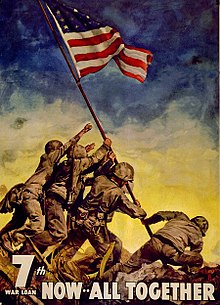
C. C. Beall's affiche for the 7th War Loan Drive
President Franklin D. Roosevelt, upon seeing Rosenthal'due south flag-raising photograph, saw its potential to use for the upcoming 7th War Loan Drive to help fund the war effort. He then ordered the flag-raisers to be identified and sent to Washington, D.C. after the fighting on the island ended (March 26, 1945).[52]
Rosenthal did not take the names of those in the photograph. On Apr 7, Rene Gagnon was the first of the second "flag-raisers" to get in in Washington, D.C. Using an enlargement of the photograph that did not prove the faces of the flag-raisers, he named himself, Henry Hansen, Franklin Sousley, John Bradley and Michael Strank, as existence in the photograph. He initially refused to name Ira Hayes, as Hayes did not want the publicity and threatened him with concrete harm.[53] However, upon being summoned to Marine headquarters and told that refusal to name the last flag-raiser was a serious offense, he identified the sixth flag-raiser as Hayes.
President Roosevelt died on April 12, 1945. On April xix, Bradley (then on crutches) and Hayes arrived in Washington, D.C. On April 20, the three surviving second flag-raisers, identified then as Gagnon, Bradley, and Hayes, met President Truman in the White House. On May 9, during a ceremony at the nation's capitol, the three men raised the original second flag to initiate the bond bout which began on May 11 in New York City. On May 24, Hayes was taken off the bout due to bug acquired by drinking booze and ordered dorsum to his company and regiment which had returned to Hawaii. Gagnon and Bradley completed the tour which concluded on July 4 in Washington, D.C. The bail drive was a success, raising $26.3 billion, twice the bout's goal.[54]
Harlon Block and Henry Hansen [edit]
Gagnon misidentified Corporal Harlon Block as Sergeant Henry O. "Hank" Hansen in Rosenthal'due south photo (both were killed in action on March ane). Initially, Bradley concurred with all of Gagnon'southward identifications. On April 8, 1945, the Marine Corps released the identification of five of the six flag raisers, including Hansen rather than Cake (Sousley's identity was temporarily withheld pending notification of his family of his expiry during the battle.) Block's mother, Belle Block, refused to have the official identification, noting that she had "changed so many diapers on that male child's butt, I know it's my boy."[55] When Hayes was interviewed about the identities of the flag raisers and shown a photo of the flag raising by a Marine public relations officer on April 19, he told the officeholder that it was definitely Harlon Block and not Hansen at the base of the flagpole. The lieutenant colonel and so told Hayes that the identifications had already been officially released, and ordered Hayes to keep silent virtually it[56] (during the investigation, the colonel denied Hayes told him about Block). Block, Sousley, and Hayes were close friends in the same squad of Second Platoon, E Company, while Hansen, who helped heighten the first flag, was a member of Third Platoon, E Company.
In 1946, Hayes hitchhiked to Texas and informed Block's parents that their son had, in fact, been one of the vi flag raisers.[57] Block'due south mother, Belle, immediately sent the letter that Hayes had given her to her congressional representative Milton West. Due west, in plow, forwarded the letter to Marine Corps Commandant Alexander Vandegrift, who ordered an investigation. John Bradley (formerly in 3rd Platoon with Hansen), upon being shown the evidence (Hansen, a erstwhile Paramarine, wore his large parachutist boots in an exposed fashion on Iwo Jima), agreed that it was probably Block and not Hansen.[58] In Jan 1947, the Marine Corps officially appear it was Cake in the photograph and not Hansen at the base of the flagpole. Hayes as well was named as being in the far left position of the flag raisers replacing the position Sousley was determined to have had up until so; Sousley was at present in back of and to the right of Strank (in 2016, Harold Schultz was named in this position and Sousley was named in the position where Bradley was named).
Ira remembered what Rene Gagnon and John Bradley could not have remembered, because they did non join the little cluster until the last moment: that it was Harlon [Cake], Mike [Strank], Franklin [Sousley] and [Hayes] who had ascended Suribachi midmorning to lay telephone wire; it was Rene [Gagnon] who had come forth with the replacement flag. Hansen had non been part of this activeness.[59]
Harold H. Schultz and John Bradley [edit]
On June 23, 2016, the Marine Corps publicly announced that Marine Corporal (then Private Showtime Course) Harold Schultz was one of the flag-raisers and Navy corpsman John Bradley was not 1 of the flag-raisers in Rosenthal's second flag-raising photograph. Harold Schultz was identified as beingness in Franklin Sousley'southward position to the right and in front of Ira Hayes, and Sousley was identified as being in Bradley'south position to the right and behind Rene Gagnon (identified as Harold Keller in 2019) behind Harlon Block at the base of the flagpole.[ii] Bradley and Schultz had been nowadays when both flags were actually raised, while Sousley was but on Mount Suribachi when he helped heighten the 2nd flag. Schultz was besides part of the group of Marines and corpsmen who posed for Rosenthal's second "gung ho" photograph.
Bradley, who died in 1994, seldom did an interview about the famous second flag-raising, occasionally deflecting questions by claiming he had forgotten.[threescore] He inverse his story numerous times, saying that he raised or pitched in to raise the flag, and as well that he was on, and not on, Mountain Suribachi when the offset flag was raised.[61] Within his family, it was considered a taboo subject field, and when they received calls or invitations to speak on certain holidays, they were told to say he was away fishing at his cottage. At the fourth dimension of Bradley'due south death, his son James said that he knew almost nothing most his father's wartime experiences.[55] James Bradley spent four years interviewing and researching the topic and published a nonfiction book entitled Flags of Our Fathers (2000) near the flag-raising and its participants.[62] The book, which was a bestseller, was later adjusted into a 2006 flick of the same name, directed by Clint Eastwood.
After being honorably discharged, Schultz moved to California and made his career with the Usa Postal Service. He died in 1995.
The possibility that any flag-raiser had been misidentified was publicly raised for the first time in November 2014 by Eric Krelle, an amateur historian and collector of World War II-era Marine Corps memorabilia, and an Irish denizen and apprentice historian named Stephen Foley.[63] Studying other photographs taken that day and video footage, Krelle and Foley argued that Franklin Sousley was in the fourth position (left to correct) instead of Bradley and Harold Schultz of Los Angeles (originally from Detroit) was in the second position, previously identified as Sousley.[63] Initially, Marine Corps historians and officials did non accept those findings, but began their own investigation.[64] On June 23, 2016, they confirmed Krelle's and Foley's findings, stating that Schultz was in Sousley'due south place, Sousley was standing side by side to Cake, and that Bradley was not in the photo at all.[65] [66] James Bradley has also changed his mind, stating that he no longer believes his male parent is depicted in the famous photograph.[67] [68] [69]
Harold Keller and Rene Gagnon [edit]
On October 16, 2019, the Marine Corps announced that Marine Corporal Harold Keller was the flag-raiser previously identified as Rene Gagnon in the Rosenthal's photograph. Stephen Foley, filmmaker Dustin Spence, and Brent Westemeyer were fundamental to this revised identification. Photos and video footage showed that the human thought to have been Gagnon had a wedding band, which matched Keller, who had married in 1944 (Gagnon was not married at the time). The man also did not have a facial mole, as Gagnon did. Finally, a photograph which captured the lowering of the beginning flag verified what Gagnon had looked similar that day, which did non match the second human being in the Rosenthal photo.[lxx]
Legacy [edit]

Rosenthal'south photograph was used as the footing for C. C. Beall's poster Now... All Together for the Seventh War Loan Drive (14 May - 30 June 1945).[71]
Rosenthal's photograph won the 1945 Pulitzer Prize for Photography, the only photo to win the prize in the same year information technology was taken.[72]
News pros were non the only ones profoundly impressed by the photograph. Navy Helm T.B. Clark was on duty at Patuxent Air Station in Maryland that Saturday when it came humming off the wire in 1945. He studied it for a minute, and and then thrust information technology under the gaze of Navy Footling Officer Felix de Weldon. De Weldon was an Austrian immigrant schooled in European painting and sculpture. De Weldon could non accept his optics off the photo. In its classic triangular lines he recognized similarities with the ancient statues he had studied. He reflexively reached for some sculptor's dirt and tools. With the photograph before him he labored through the dark. Within 72 hours of the photo'south release, he had replicated the six boys pushing a pole, raising a flag.[48] [73]
Upon seeing the finished model, the Marine Corps commandant had de Weldon assigned to the Marine Corps[74] until de Weldon was discharged from the Navy afterwards the war was over.
Starting in 1951, de Weldon was commissioned to design a memorial to the Marine Corps. It took de Weldon and hundreds of his assistants three years to finish it. Hayes, Gagnon, and Bradley, posed for de Weldon, who used their faces every bit a model. The iii Marine flag raisers who did not survive the boxing were sculpted from photographs.[75]
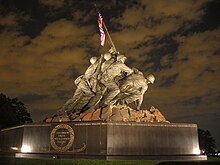
The flag-raising Rosenthal (and Genaust) photographed was the replacement flag/flagstaff for the first flag/flagstaff that was raised on Mount Suribachi on February 23, 1945. At that place was some resentment from onetime Marines of the original 40-human being patrol that went up Mountain Suribachi including by those involved with the first flag-raising, that they did not receive the recognition they deserved. These included Staff Sgt. Lou Lowery, who took the first photos of the starting time flag flying over Mt. Suribachi; Charles W. Lindberg, who helped necktie the first American flag to the first flagpole on Mount Suribachi (and who was, until his death in June 2007, one of the concluding living persons depicted in either flag-flying scene),[76] who complained for several years that he helped to raise the flag and "was called a liar and everything else. It was terrible" (because of all the recognition and publicity over and directed to the replacement flag-raisers and that flag-raising);[77] and Raymond Jacobs, photographed with the patrol commander around the base of operations of the first flag flying over Mt. Suribachi, who complained until he died in 2008 that he was still not recognized past the Marine Corps by name as existence the radioman in the photo.
The original Rosenthal photograph is currently in the possession of Roy H. Williams, who bought information technology from the manor of John Faber, the official historian for the National Printing Photographers Association, who had received it from Rosenthal.[78] Both flags (from the get-go and 2nd flag-raisings) are now located in the National Museum of the Marine Corps in Quantico, Virginia.[79]
Ira Hayes, following the war, was plagued with depression brought on by survivor guilt and became an alcoholic. His tragic life, and death in 1955 at the age of 32, were memorialized in the 1961 motion motion-picture show The Outsider, starring Tony Curtis every bit Hayes, and the folk song "The Ballad of Ira Hayes", written past Peter LaFarge and recorded past Johnny Cash in 1964.[80] Bob Dylan later covered the song, as did Kinky Friedman.[81] According to the vocal, after the war:
So Ira started drinkin' hard
Jail was oftentimes his home
They'd let him raise the flag and lower it
Like y'all'd throw a domestic dog a bone!
He died drunk early on one mornin'
Alone in the land he fought to save
2 inches of water in a lone ditch
Was a grave for Ira Hayes.
Rene Gagnon, his wife, and his son visited Tokyo and Mount Suribachi on Iwo Jima during the 20th anniversary of the battle of Iwo Jima in 1965.[82] Later the state of war, he worked at Delta Air Lines every bit a ticket amanuensis, opened his own travel bureau, and was a maintenance director of an apartment circuitous in Manchester, New Hampshire. He died while at work in 1979, age 54.[83] [ page needed ] [84]
In other media [edit]

U.South. postage postage, 1945 issue, commemorating the battle of Iwo Jima

Rosenthal'south photograph has been reproduced in a number of other formats. It appeared on 3.5 one thousand thousand posters for the seventh state of war bond drive.[51] It has also been reproduced with many unconventional media such equally Lego bricks, butter, water ice, Etch A Sketch and corn mazes.[85]
The Iwo Jima flag-raising has been depicted in other films , including 1949's Sands of Iwo Jima (in which the three surviving flag raisers make a cameo appearance at the end of the motion-picture show) and 1961's The Outsider, a biography of Ira Hayes starring Tony Curtis.[86]
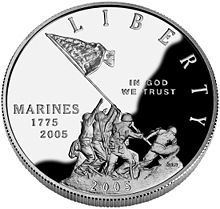
In July 1945, the U.s.a. Postal service released a postage stamp bearing the image.[87] The U.S. issued some other postage stamp in 1995 showing the flag-raising equally part of its x-postage stamp serial marker the 50th anniversary of World State of war Ii.[87] In 2005, the United States Mint released a commemorative silvery dollar bearing the image.
A like photograph was taken by Thomas E. Franklin of the Bergen Record in the immediate backwash of the September 11 attacks. Officially known equally Ground Nothing Spirit, the photograph is perhaps improve known as Raising the Flag at Ground Zero, and shows iii firefighters raising a U.S. flag in the ruins of the World Trade Center soon after 5 pm.[88] Painter Jamie Wyeth likewise painted a related image entitled September 11th based on this scene. It illustrates rescue workers raising a flag at Ground Zero. Other iconic photographs oftentimes compared include V-J Day in Times Foursquare, Into the Jaws of Death, Raising a Flag over the Reichstag, and the Raising of the Ink Flag.[89]

The highly recognizable prototype is one of the most parodied photographs in history.[85] Anti-war activists in the 1960s altered the flag to bear a peace symbol, as well as several anti-institution artworks.[xc] Edward Kienholz's Portable War Memorial in 1968 depicted faceless Marines raising the flag on an outdoor picnic tabular array in a typical American consumerist environment of the 1960s.[91] [92] Information technology was parodied again during the Iran hostage crisis of 1979 to draw the flag being planted into Ayatollah Ruhollah Khomeini's backside.[xc] In the early on 2000s, to represent gay pride, photographer Ed Freeman shot a photograph[93] for the comprehend of an result of Frontiers magazine, reenacting the scene with a rainbow flag instead of an American flag.[94] Time magazine came under burn in 2008 after altering the image for use on its cover, replacing the American flag with a tree for an upshot focused on global warming.[90] The British Airlines Stewards and Stewardesses Association likewise came under criticism in 2010 for a poster depicting employees raising a flag marked "BASSA" at the edge of a runway.[xc]
Amidst the smaller scale replicas of the Marine Corps War Memorial based on the flag raising is one as well sculpted by Felix de Weldon at Marine Corps Recruit Depot Parris Island on the Peatross Parade Deck. For the finale of The Crucible, the Marines' 54-60 minutes final training test, Marine recruits at Parris Island hike ix miles to the statue as the sun rises and the flag is raised. They and so are addressed on the flag raising and its meaning and are then awarded their Eagle, World and Anchor emblems by their drill instructors signifying them as full-fledged Marines.[95]
Encounter also [edit]
- The Ink Flag
- Shadow of Suribachi: Raising the Flags on Iwo Jima
- Raising a Flag over the Reichstag
- Raising the Flag on the Three-Country Cairn
- Raising the Flag at Ground Zero
- History of the Us Marine Corps
- C. C. Beall
References [edit]
- ^ "Arlington Ridge Park, George Washington Memorial Parkway". National Park Service. July 3, 2012. Retrieved November 10, 2016.
- ^ a b c d USMC Argument on Marine Corps Flag Raisers, Office of U.Due south. Marine Corps Communication, 23 June 2016
- ^ "Warrior in iconic Iwo Jima flag-raising photo was misidentified, Marines Corps acknowledges". Nbcnews.com. Retrieved July 1, 2020.
- ^ Liberatore, Paul (November 10, 2017). "Iwo Jima flag photographer Joe Rosenthal special honor sought". Marin Independent Journal . Retrieved December 17, 2018.
- ^ Weinberg 1994, pp. 866–868.
- ^ Leckie 1967, p. iii.
- ^ "Charles Lindberg, 86; Marine helped raise first U.S. flag over Iwo Jima". Los Angeles Times. Associated Press. June 26, 2007. Retrieved November 6, 2013.
- ^ Willie 2010, p. 97.
- ^ Robertson, Neimeyer & Nash 2019, pp. xix–xxi.
- ^ Robertson, Neimeyer & Nash 2019, p. 48.
- ^ a b David Knopf (Jan 2, 2012). "Camden-Fleming man an unsung hero at Iwo Jima". Richmond News . Retrieved March 12, 2014.
{{cite news}}: CS1 maint: url-status (link) [ dead link ] - ^ Bradley 2006, p. 306.
- ^ Lance Hernandez (Feb 14, 2016). "World War Ii 'Hero of Iwo Jima,' John Keith Wells, dies in Arvada". The Denver Aqueduct . Retrieved March 16, 2016.
- ^ a b G. Greeley Wells (October 17, 1991). "The Man Who Carried the Flag at Iwo Jima". The New York Times. p. A26.
- ^ Lucas, Dean (July ix, 2007). "Famous Pictures Magazine – Raising The Flag On Iwo Jima". Famous Pictures Magazine. Retrieved May 23, 2013.
- ^ Bradley, John H. (January sixteen, 2008). "Oral History – Iwo Jima Flag Raising: Recollections of the flag raising on Mount Suribachi during the Battle of Iwo Jima by Pharmacist Mate Second Class John H. Bradley, USN, with the 5th Marine Sectionalization". Navy Department Library – Oral Histories (Interview). Naval History and Heritage Command. Retrieved January 6, 2022.
- ^ Rural Florida Living. CBS Radio interview past Dan Pryor with flag raiser Ernest "Boots" Thomas on February 25, 1945 aboard the USSEldorado: "Three of united states of america really raised the flag".
- ^ Robertson, Neimeyer & Nash 2019, p. 15.
- ^ Alexander 1994, sec. 4.
- ^ Alexander 1994, comprehend.
- ^ Brown 2019.
- ^ Bradley 2006, p. 205.
- ^ Warren 2007, p. lxx.
- ^ Clancy 1996, p. 670.
- ^ a b Bradley 2006, p. 207.
- ^ Robertson, Neimeyer & Nash 2019, p. xix.
- ^ Buell 2006, pp. 104, 221.
- ^ Bradley 2006, p. 210.
- ^ "Alan Forest, Usa veteran who provided flag for Iwo Jima moving picture, dies anile 90". The Guardian. Associated Printing. April 28, 2013. Retrieved May 26, 2013.
- ^ Chawkins, Steve (April 25, 2013). "Alan Woods dies at 90; provided Iwo Jima flag in Earth War II". Los Angeles Times . Retrieved May 26, 2013.
- ^ Scott, David Clark (Apr 27, 2013). "Alan Wood dies, leaves legacy of Iwo Jima flag". Christian Science Monitor . Retrieved May 26, 2013.
- ^ Boxing of Iwo Jima: Alan Wood and the Famous Flag on Mount Suribachi HistoryNet, June 12, 2006
- ^ Patterson, Rod (June thirteen, 1973). "Fame Eludes Creator Of Iwo Jima banner". The Oregonian.
- ^ "LST-758". navsource.org.
- ^ "Coast Baby-sit Linked to Iwo Jima". jacksjoint.com.
- ^ "USS LST-758" (PDF). uscg.mil.
- ^ USCG Veteran Provided Stars and Stripes for U.Southward. Marines Silverstein, Judy L.; U.S. Coast Guard.
- ^ Kime, Patricia (December 12, 2005). "Iwo Jima flag legend puts services at odds". armytimes.com . Retrieved May 29, 2012.
- ^ Farhi, Paul (Feb 22, 2013). "The Iwo Jima photo and the man who helped save it". The Washington Postal service, p. c1 [1]
- ^ Peppery, Glenn (Feb 2004). "Iwo Jima flag raising A Brief History". Marine Corps League. Archived from the original on Apr xvi, 2012. Retrieved May thirty, 2012.
- ^ Rubin, Cyma; Newton, Eric, eds. (2011). The Pulitzer Prize Photographs. Newseum Inc. ISBN978-0-9799521-iii-five.
- ^ a b c Rosenthal, Joe; Heinz, West.C. (February eighteen, 1955). "The Picture that will Live Forever". Collier's Mag. Crowell-Collier Publishing Company. Archived from the original on March 23, 2013. Retrieved Apr 18, 2016.
{{cite magazine}}: CS1 maint: unfit URL (link) - ^ Bradley 2006, pp. 209–211.
- ^ Robertson, Neimeyer & Nash 2019, p. eighteen.
- ^ Robertson, Neimeyer & Nash 2019, p. 23.
- ^ "This Is America – Six Men, a World War, a Pacific Island and an Epitome for All Time". Manythings.org. May 30, 2010. Retrieved May 29, 2012.
- ^ Hemmingsen, Steve (November 11, 2005). "Hemmingsen: A Developing Story". Keloland Television. Archived from the original on Apr 4, 2012. Retrieved May 29, 2012.
- ^ a b Bradley 2006, p. 220.
- ^ "Center for American History Spring 2005 Newsletter" (PDF) . Retrieved May 29, 2012.
- ^ Upson, Cyd (Feb 19, 2009). "Fact or Fiction: Was the Photo of the Iwo Jima Flag-Raising Staged?". foxnews.com . Retrieved May 30, 2012.
- ^ a b c d Landsberg, Mitchell. "L Years Later, Iwo Jima Photographer Fights His Own Battle". Associated Press. Archived from the original on April 12, 2004. Retrieved May 30, 2012.
- ^ Robertson, Neimeyer & Nash 2019, p. xviii.
- ^ Bradley 2006, p. 268.
- ^ Bradley 2006, p. 294.
- ^ a b Bradley, James J. (October 3, 2001). Leadership and Doing the Incommunicable (Spoken communication). Zeien Lecture Serial. Webb Institute. Archived from the original on June xv, 2013. Retrieved November six, 2013.
- ^ Bradley 2006, p. 275.
- ^ Bradley 2006, p. 312.
- ^ Bradley 2006, p. 313.
- ^ Bradley 2006, p. 274.
- ^ Bradley 2006, p. 343.
- ^ "John Bradley's Account of the Iwo Flag Raising". July 1, 2016.
- ^ Bradley 2006, p. v.
- ^ a b Hansen, Matthew (November 23, 2014). "New mystery arises from iconic Iwo Jima image". Omaha Globe-News . Retrieved May 3, 2016.
- ^ Times, Marine Corps (November 26, 2014). "marine-corps-history-disputed". Marine Corps Times.
- ^ McFeteridge, Scott (May 2, 2016). "Marines investigating merits about men in Iwo Jima photo". Tampa Bay Times. Associated Press. Retrieved February 28, 2022.
- ^ Schmidt, Michael Southward. (June 23, 2016). "Man in Iwo Jima Flag Photo Was Misidentified, Marine Corps Says". The New York Times . Retrieved February 28, 2022.
- ^ Schmidt, Michael S. (May iii, 2016). "'Flags of Our Fathers' Writer Now Doubts His Male parent Was in Iwo Jima Photo". The New York Times . Retrieved May 3, 2016.
- ^ Mcfetridge, Scott (May 3, 2016). "Detroit Marine could be in iconic Iwo Jima photo". The Detroit News, Associated Press. Retrieved May 22, 2016.
- ^ Hansen, Matthew (May 6, 2016). "Hansen: Subsequently studying OWH column, 'Flags of Our Fathers' author James Bradley says father isn't in iconic Iwo Jima photo". Omaha Globe-Herald . Retrieved May 22, 2016.
- ^ "Warrior in iconic Iwo Jima flag-raising photo was misidentified, Marines Corps acknowledges". NBC News. October 16, 2019. Retrieved October 30, 2019.
- ^ Robertson, Neimeyer & Nash 2019, pp. 63–65.
- ^ Fischer, Heinz-D.; Fischer, Erika J. (2003). Complete historical handbook of the Pulitzer Prize system, 1917–2000 decision-making processes in all honour categories based on unpublished sources. München: K.G. Saur. pp. 200–201. ISBN9783110939125.
- ^ The Washington Mail (June nine, 2003). "Felix De Weldon, 96, Iwo Jima Memorial Sculptor". Sun Sentinel. South Florida. Retrieved Jan 29, 2012.
The epitome mesmerized Mr. de Weldon, who began sculpting a model the 24-hour interval the photo was released...a model that he completed in 72 hours.
- ^ Martin, Douglas (June 15, 2003). "Felix de Weldon Is Dead at 96; Sculptured Memorial to Marines". New York Times . Retrieved Jan 29, 2012.
When his finished work was wheeled into the office of the Marine Corps commandant, the man was so impressed that he transferred Mr. de Weldon into the Marine Corps.
- ^ "USMC War Memorial". National Park Service. Archived from the original on April xx, 1999. Retrieved May 30, 2012.
- ^ "The Concluding Flag Raiser". Mediatechnics.com. Archived from the original on March 8, 2005. Retrieved May 30, 2012.
- ^ Wurzer, Cathy; Siple, Julie (February 18, 2005). "Vets withal fight Iwo Jima flag flap". Minnesota Public Radio. Retrieved May 30, 2012.
- ^ Williams, Roy H. (2003). "An Island in WWII". invisibleheroes.com . Retrieved May 29, 2012.
- ^ "Collections of the National Museum of the Marine Corps". Usmcmuseum.org. Retrieved May 30, 2012.
- ^ Turner, Steve (2004). The Man Chosen Cash: The Life, Love and Faith of an American Fable. Thomas Nelson Inc. p. 2. ISBN978-1-4185-7809-1.
- ^ Dunn, Tim (2008). The Bob Dylan Copyright Files 1962–2007. AuthorHouse. p. 41. ISBN978-one-4389-1589-0.
- ^ Drake, Hal (February 21, 1965) Flag raiser'south return To Iwo Jima: 'It all seems impossible' [2] Stars and Stripes
- ^ Buell 2006.
- ^ Duckler, Ray (Concord Monitor, May 25, 2014) Ray Duckler: Son of Marine in iconic photo pays tribute to his male parent "Archived re-create". Archived from the original on March 4, 2016. Retrieved January 5, 2015.
{{cite web}}: CS1 maint: archived copy as title (link) Retrieved Jan 4, 2015 - ^ Burrell, Robert Southward. (2006). The Ghosts of Iwo Jima. Texas A&M University Press. pp. 178, 246. ISBN978-1-58544-483-0.
- ^ a b "Battle of Iwo Jima" (PDF). Veterans and the War machine on Stamps. Us Postal Service. p. 20. Retrieved Nov 6, 2013.
- ^ "Virtually the Photo". Ground Zero Spirit. N Jersey Media Group Foundation. Retrieved November 6, 2013.
- ^ Aderet, Ofer (September 29, 2012). "Sometime IDF Full general Israeli Icon Avraham Adan Dies at 86". Haaretz Newspaper in State of israel. Haaretz Daily Newspaper Ltd. Retrieved July 24, 2017.
- ^ a b c d Lamothe, Dan (March 15, 2010). "BASSA-ckward: British labor group alters iconic Marine image". Marine Corps Times. p. 6.
- ^ Willick, Damon (May 6, 1996). "Skilful forenoon, my proper noun is Ed Kienholz". Contemporary Art Quarterly. Archived from the original on May 12, 2012. Retrieved May 30, 2012.
- ^ Upshaw, Reagan (1996). "Scavenger's Parade: the Edward Kienholz Retrospective Now on View in Los Angeles Reviews the Career of a Pioneer of American Postwar Assemblage". Fine art in America. Vol. 84, no. 10. pp. 98–107.
- ^ "Gay Pride High-Res Stock Photography". Getty Images. Archived from the original on March 10, 2018. Retrieved Feb 19, 2020.
- ^ "Iwo Jima Marines, gay pride and a photo adaptation that spawns fury". The Washington Mail . Retrieved July 2, 2015.
- ^ Recruit Preparation – Crucible Marine Corps Recruit Depot Parris Island
Bibliography [edit]
- Alexander, Joseph H. (1994). Closing In: Marines in the Seizure of Iwo Jima. Marines in World State of war II Commemorative Series. Washington, D.C.: History and Museums Division, Headquarters, U.S. Marine Corps. OCLC 32194668.
- Bradley, James (2006) [2000]. Flags of Our Fathers. New York: Runted. ISBN978-0-553-38415-four.
- Brownish, Rodney (2019). Iwo Jima Monuments: The Untold Story. War Museum. ISBN978-ane-7334294-3-half-dozen . Retrieved November 10, 2020.
- Buell, Hal (2006). Uncommon Valor, Common Virtue: Iwo Jima and the Photograph that Captured America . Berkeley, California: Berkeley Publishing Grouping/Penguin Group. ISBN978-0-425-20980-half-dozen.
- Clancy, Tom (1996). Marine: A Guided Bout of a Marine Expeditionary Unit. Penguin Group U.s.a.. ISBN978-one-4295-2009-6.
- Leckie, Robert (1967). The Boxing of Iwo Jima . New York: Random House. ISBN978-0394904184.
- Robertson, Breanne; Neimeyer, Charles; Nash, Douglas (2019). Investigating Iwo: The Flag Raisings in Myth, Memory & Esprit de Corps (PDF). Marine Corps History Segmentation. ISBN978-1732003071.
 This article incorporates text from this source, which is in the public domain .
 - Warren, James A. (2007). American Spartans: The U.Due south. Marines: A Combat History from Iwo Jima to Iraq . New York: Simon and Schuster. ISBN978-1-4165-3297-2.
- Weinberg, Gerhard L. (1994). A Earth at Arms: A Global History of Earth War II. Cambridge; New York: Cambridge University Press. ISBN978-0-521-55879-2.
- Willie, Clarence E. (2010). African American Voices from Iwo Jima: Personal Accounts of the Battle. McFarland. ISBN978-0-7864-5694-9.
External links [edit]
- Raising the Flag on Iwo Jima: The most parodied photo in history?
- Captain Dave Severance talks about the Battle of Iwo Jima and raising the flag
- Chlosta, SSgt Matthew, U.S. Army (July 6, 2007). "JPAC investigation team returns from Iwo Jima (re: William Genaust)". Joint Prisoner of war/MIA Bookkeeping Command (JPAC). Archived from the original on November 5, 2011.
- 2nd Globe State of war – Mass on Mountain Suribachi
Source: https://en.wikipedia.org/wiki/Raising_the_Flag_on_Iwo_Jima
0 Response to "The American Flag Is Carried Into Battle for the First Time Art"
Post a Comment