Milestones Are Formal Review Points That Tend to Lengthen the Innovation Process
What is a Production Development Process?
A Production Evolution Process refers to the entire range of activities where a visitor conceptualizes and realizes a new offering. A production concept might originate in the marketplace, or in a lab or workspace, or in the so-called fuzzy front stop. Ideas come from customer requirements, as well.
New product development normally follows a process divided into stages, phases or steps, past which a company conceives a new product idea and then researches, plans, designs, prototypes, and tests it, before launching it into the market place.
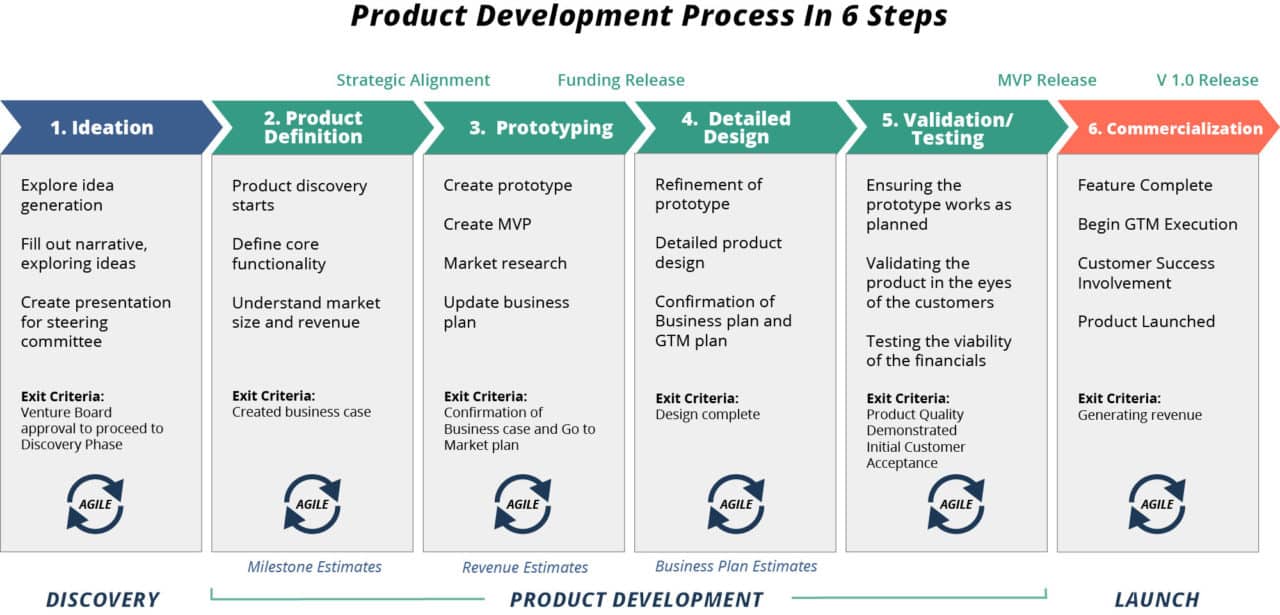
The product development process is the specific series of steps or stages a company uses to achieve its realization of new offerings to satisfy a market demand. While nearly every visitor develops new products or services, product development processes differ substantially from one company to another depending on the industry, the production type, whether the products are an incremental improvement or a breakthrough innovation. This is probably the virtually impactful form of process management that a visitor can undertake, besides managing the product life cycle itself.
In many cases, since organizations rarely focus on this, a product direction consulting engagement or a product development consulting date tin provide the right kind of outside guidance – especially if the gains are in the front end of development.
An accepted approach for more than three (or more!) decades puts a new product thought through a series of steps. These steps culminate in an up-or-down determination fabricated by the Senior Management team in a formal review (often called a "gate") at the end of each phase.
Are you struggling with your production evolution? Are your programs not delivering?
- Products Late and Don't Meet Expectations?
- Development unpredictable?
- Time to Market As well Long?
The 6 Steps of Production Evolution [NPD]
A typical product evolution process has 6 steps with five gates.
- Step 1: Idea Generation (Ideation)
- Step 2: Product Definition
- Stride 3: Prototyping
- Step 4: Detailed Design
- Pace 5: Validation/Testing
- Step half-dozen: Commercialization
1. Thought Generation (Ideation)
This first step or stage of the Product Evolution process, often chosen "Ideation," is where new product concepts originate. Often this stride is a event of an idea screening to select the next production attempt, and is more conspicuously defined in new production development. Following best practices, businesses grade a small team to explore the production roadmap and perform…
- The initial definition of the product concept
- Business assay (including SWOT assay)
- Market place inquiry
- Technical and market gamble
The idea phase is often the most of import step for brainstorming new products because information technology is where most product ideas come from. Sometimes a SWOT analysis (strengths, weaknesses, opportunities and threats) analysis is used as a vehicle to prioritize ideas in this first step.
From Thought, To Concept, to MVP
Often production development starts out with a product manager realizing that the sales are lagging their forecasts because it is late in the production life cycle. The director wants to act, but sometimes they lack a methodology. Other times the motivation is that someone in engineering (or sales) comes up with a bare idea out of the blueish, not driven by the product development bike (not all products come from product managers!), but considering of some independent brainstorming. Finally, information technology can come out of a deliberate marketing strategy and product roadmap.
In all cases, product managers need to turn an idea into a concept. Once you accept a concept firmly in mind, yous tin can call back about concept development and testing with prospective customers to make certain y'all are on the right grade. If the concept is super simple, y'all could even get directly to a Minimum Viable Product (MVP) and start getting existent feedback .
Getting the production concept wrong at this early stage wastes fourth dimension and increases opportunity cost. Notation not all new product ideas come up from the inside – the Corporate Development arrangement and executives should exist constantly scanning for new product ideas. Marketing efforts should too including active competitive assay and market scanning. Engineering should be brainstorming, too.
It is at this stage where the target market, target audience (including Personas) and target customers are proposed. If the product goes through distribution, and then the distributors are included as customers in this ideation step. Idea screening is performed in this phase.
2. Product Definition (Discovery)
Sometimes called "scoping," or concept development, this step involves refining the definition of the product concept and ensuring that the team really understands customer requirements. In a startup this step is often called Discovery. The blueprint squad is assembled in this phase. The team creates the first detailed assessment of the technical, marketplace and business aspects of the new product concept and determines core functionality. A template, or approach, for blueprint thinking might be useful in getting started.
Sometimes mockups are used to obtain early feedback on product market fit. These mockups can be primitive, for example paper prototypes are commonly used to get early feedback from examination marketing. If this is an incremental production, then concept design tin can brainstorm. For quantum products, the team may consider simulations to become user feedback. The newer the product category is to the company, the more concept testing is required. The bones goal of product discovery techniques is to ensure that the ideas are good and volition satisfy customers.
Concept pattern often begins in this phase. The design team can begin to visualize the end production and can communicate this to potential customers (in software, this simpler than in a complex arrangement or hardware production).
Marketing Strategy Development
Developers and managers explore and define the key points of differentiation for the new product. This step in development, if done improperly, can increment fourth dimension to market or cause the product to misunderstand the needs of the market. Considering this footstep is often earlier actually ramping upwards the team, the alignment with the production development strategy is too very important. Although it is early, oftentimes metrics such every bit ARR (Annual Recurring Revenue) or Conquering Costs are estimated. Clearly a product roadmap tin can be instrumental in guiding (or developed with) the marketing strategy.
Business Analysis
After the first stage of development, business assay is performed. The team would expect at like products, perform a competitive analysis, and begin to map out the distribution strategy, including ecommerce. This is washed to ensure the margins returned to the firm volition meet thresholds. The market strategy will also guide the estimates of advertising and PR, once again which weigh into the ROI calculation for the new production. Often a three year Profit and Loss plan is part of the business analysis.
Development Costs
As part of the concern analysis, and with an understanding of the product definition, the team can develop estimates of development costs at this stage of the evolution cycle. This cost besides goes into the business assay in order to calculate ROI or IRR metrics.
iii. Prototyping
This footstep in the product development procedure justifies the company's investment in the development of a product by requiring the squad to create a detailed business programme. Best practices usually involve intensive marketplace research and a clear projection management approach. The team thoroughly explores the competitive landscape for the new product and where the proposed product fits within it, while also creating a financial model for the new offering that makes assumptions nearly market place share. Besides concept testing, pricing is determined in this step.
For tangible new products, such as hardware or mixed systems, the team also considers the manufacturability of the proposed new product, and this includes the sourcing of the product if out sourced. By the stop of this stage, Senior Management should accept a clear thought of what they're investing in and how it will perform in the marketplace.
This third step in the product evolution process is critical considering information technology reduces the market place risk for the new product. This is the stage where y'all tin perform test marketing because of the being of prototypes that you tin can show to customers. Software evolution tin can do these tests before considering of the relative ease of creating realistic user interfaces.
four. Detailed Pattern
In this phase, the focus is on product pattern but likewise refinement of the prototype of the product. In most cases teams alpha-test the paradigm, working with customers in an iterative way: getting their feedback and incorporating it into the epitome. In parallel, marketing, sales and manufacturing brainstorm to create the launch and manufacturing platforms to back up the emerging production. This fourth step in the product evolution process is sometimes chosen Development, and sometimes incorporates the next footstep, "Validation/Testing."
5. Validation and Testing
Validation and testing means ensuring the image works equally planned. It as well means validating the production in the eyes of the customers and markets, while testing the viability of the financial model for the product.
Everything in the business case, and everything learned from customers during the Development stage comes nether scrutiny and is tested in "real world" atmospheric condition as much as possible. The marketing strategy is also confirmed at this signal. If annihilation in the business example or prototype needs revising, this is the team's last run a risk to practise so. This is the concluding step earlier the final product is fix for the marketplace. Frequently exam marketing, or beta testing (depending on the type of product), is performed at this stage to help validate the go to market plan.
6. Commercialization
During this step of the product development process (including the manufacturing procedure), the team realizes everything required to bring the final product to market, including marketing and sales plans (or sales grooming if necessary) for the market introduction. The team, including project direction, begins to operationalize the manufacture and customer support for the product and supports the product introduction. That is why this step is called the Commercialization Phase. Test marketing may go on to enable the company to take the greatest success with the launch.
Gate Reviews
Each of these six phases ends in a gate review where the squad presents to management specific, pre-divers deliverables, and demonstrates the outcomes required to motion on to the next phase of the product development process. Each of these reviews ends in a get/no-go conclusion. In other words, Management has 5 opportunities to kill the projection earlier committing to its launch.
However, the earth is moving abroad from this waterfall product development approach. It is too process heavy and encourages unnecessary meddling from Senior Management. Compare your gate reviews and other aspects of the process with our product evolution checklist.
Waterfall vs Agile Product Development Processes
Currently, there are two principal approaches to the product development process – and we know this through example study after case study. The starting time is a waterfall approach, a generic term for traditional product evolution in which at that place are detached steps and milestones. It is called waterfall product evolution because, in this approach, teams keep on to the next stages just after milestones are met, i.e. the flow is one directional merely. Nosotros often see these types of stages and gates processes in our direction consulting engagements. Most companies want a methodology that blends these ii approaches – a and then called hybrid approach.
Active Production Development Process
Agile product evolution processes, on the other hand, are increasingly more than common because they tin create new products that delight customers using fewer resources. The Agile arroyo relies on sprints, cycles that combine development with customer testing. Most all organizations that say they are Active are really using Agile betwixt major milestones to develop their products. This is a hybrid approach that offers the best of both worlds and an approach used in our agile consulting.
The Minimum Feasible Process approach involves a subtle only important change in thinking. While the phases and gates approach contains a series of sequential steps, the Minimum Viable Procedure recognizes that each portion of the process has many activities washed concurrently and iteratively. Rather than fulfilling a rigid set of deliverables, the team engages with Senior Management in iii check-ins that show that the concept is sound, that there is a fit betwixt the market place and the production, and that everything is prepared for the product launch. These cheque-ins demonstrate that continued investment is warranted.

Rather than having pre-gear up deliverables and outcomes that the team must come across in gild to pass a review, the squad continues to affirm throughout the process that it is meeting a set of broad parameters that define the project. Frequently these cardinal deliverables are determined in a product evolution consulting engagement, where best practices are imported and modified to fit your unique situation. If it'due south meeting these parameters, Management should leave the team alone; if it's not meeting them, then the team needs a lean escalation process to inform the Senior Management and get back on track.
Here's how it works. At the offset of a project, possibly afterwards having a product idea only before the company invests big dollars, the development team and Senior Management squad come to an understanding around fundamental parameters for the project such as:
- Product Toll
- Features
- Schedule
- Quality
- Reliability
These parameters must have a quantitative threshold that the team must not exceed, as in the diagram below. We telephone call these quantitative parameters boundary atmospheric condition. This approach implies that the team has already washed sufficient homework to gear up these parameters accurately and to brand them quantitative.
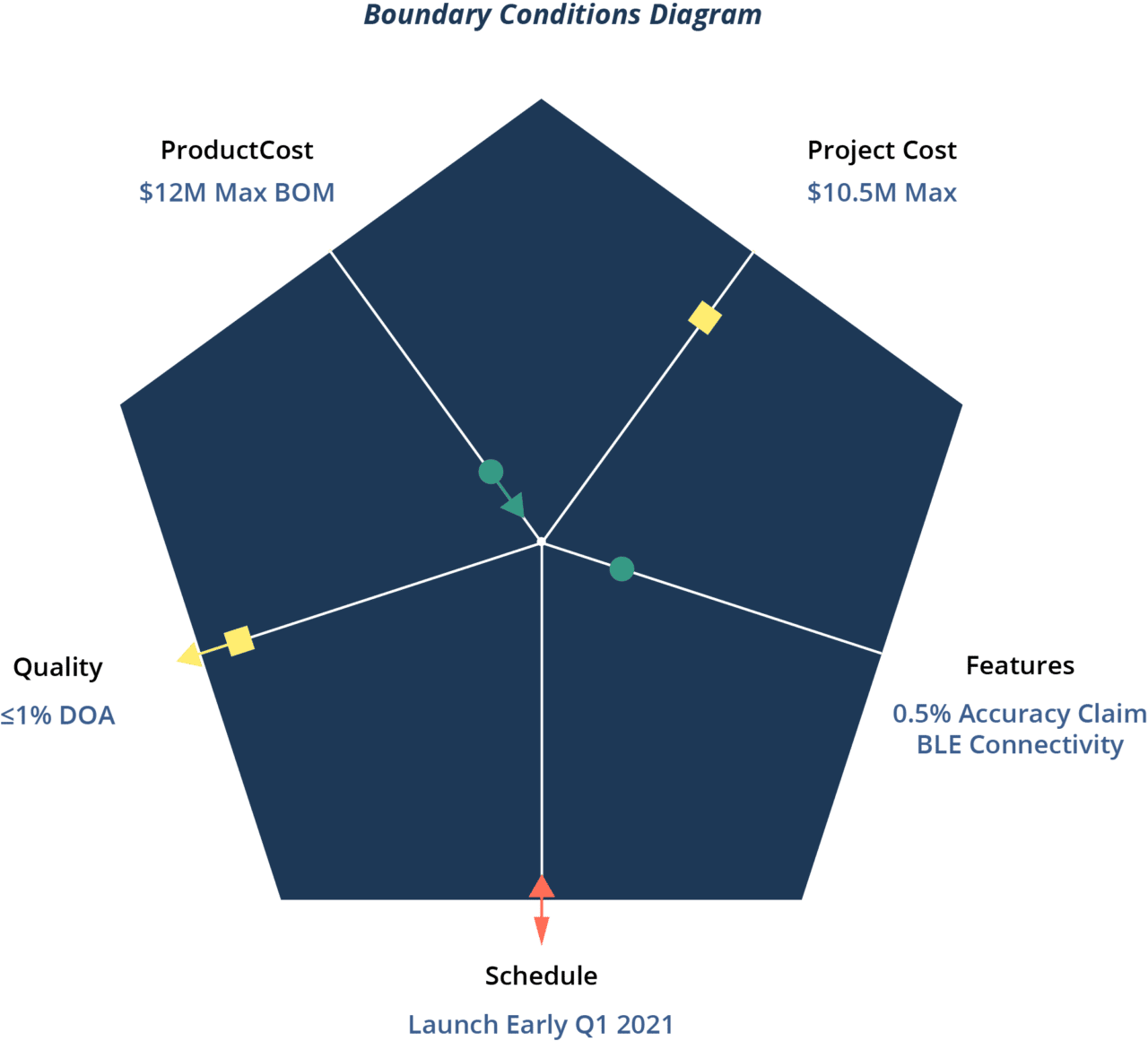
One time the team and direction agree to these boundary conditions, the team is left alone to reduce the risks associated with meeting each condition. If it looks as though the team is on track to achieve its aims, then Direction does not meddle.
In add-on, In a Minimum Viable Process there are no rigid reviews with a pre-fabricated set of deliverables. These reviews are replaced by the iii cheque-ins throughout the process where the development squad meets Direction's demand to ensure that its investment is protected. They demonstrate the viability of this continued investment past showing that the evolution squad is reducing take chances in every believable category: market risk, technical risk, competitive risk, etc.
If at any time – and not just at predetermined "gates" – the team perceives that it will not reach 1 or more than of its purlieus atmospheric condition (called a "boundary interruption"), then the development team informs the Senior Management team and there follows an escalation process called an Out-of-Bounds Review.
In such a review, the team communicates about the boundary status break they conceptualize. The team also proposes a solution to the purlieus pause. If the Management squad agrees with this solution, then they approve information technology and the team moves forrard on this ground. If the Management team does not hold with the proposed solution, then in that location follows a face-to-face coming together where all stakeholders negotiate a new purlieus condition. The team then gain based on this new specification. Such reviews should take place in days or in a week, and not in weeks or months.
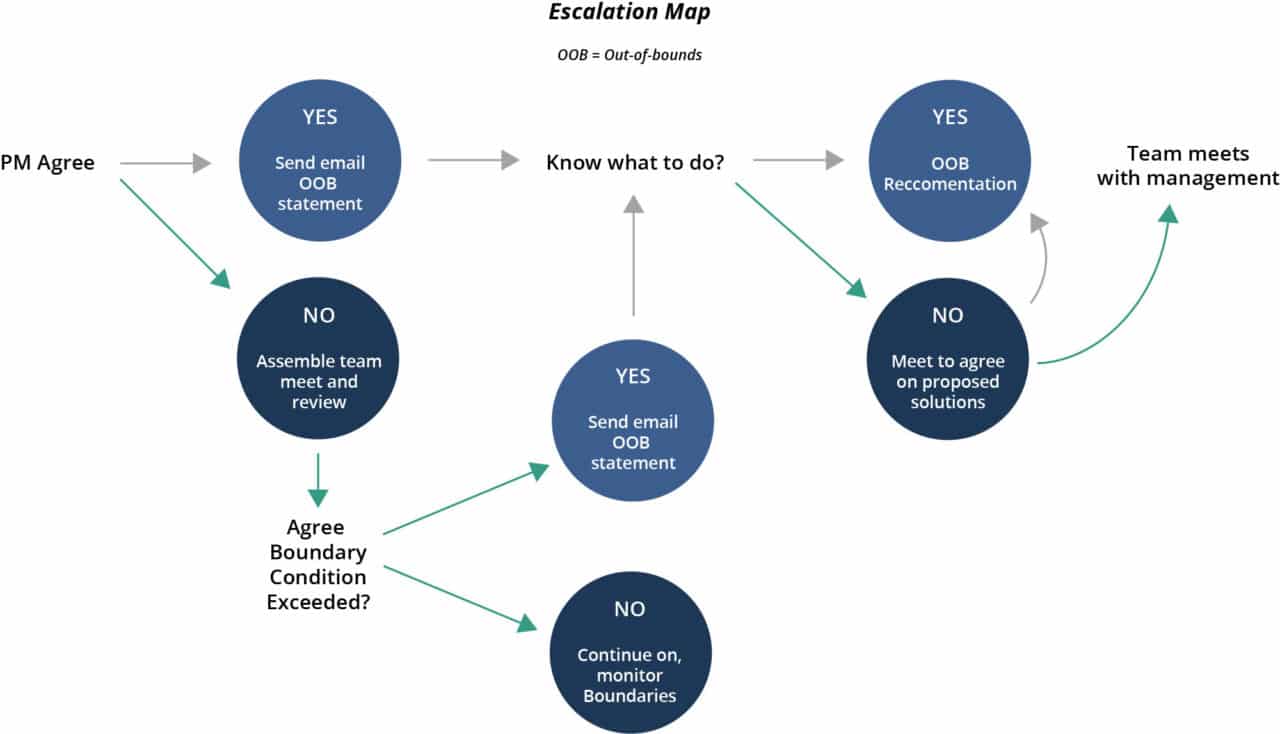
Establishing Boundary Conditions coupled with the Out-of-Bounds reviews reduces bureaucracy and paperwork. It is a lean approach to new product development where problems are resolved speedily. Near importantly information technology preserves the Management team'due south conviction in their investment, while guiding the development squad to continually reduce risk, by working to a clear set of objective parameters.
From Vi Steps to Three
A Minimum Feasible Process has a maximum of iii major steps, with three check-ins after each step.
- Step i: Concept Fit
- Step 2: Product/Market place Fit
- Step 3: Evolution
Call up of each of these phases as having a set of activities associated with it and exit criteria that the team must fulfill to enter the post-obit stage. Here are the typical activities and criteria for each of these three phases:
Step 1: Concept Fit
Activities for the Concept Fit stage ensure that production ideas are the all-time product ideas…
- Production ideas are coinciding with the vision
- The squad is free to innovate and iterate
- The technology is tested
- Projects are staffed properly with the right resources
- Projects are gratuitous from anything that impedes fast and iterative development
- At that place is a meaningful commercial potential
By the end of this phase, the team should have a clear leader with entrepreneurial adequacy. The team should demonstrate to management that the time-to-revenue is foreseeable, the potential market share big, and that the acquirement potential is large plenty to make a difference to the company. The proposed business model should be adjacent to the company's overall model. That means that the concern model for the project should resemble how the company, in general, does business.
There are as well brand and client issues to consider in this phase. This stage should include market place research and analyze how the proposed product will leverage the company'due south brand, and the team should exist able to depict the product's unique value proposition. The team should as well consider the proposed production's fit with the current distribution channels and its projected customer base.
At the end of this phase, the development team has a cursory cheque-in with management to plant the Boundary Conditions for the project and to ensure that the proposed project meets the company's current strategic priorities.
Step 2: Product/Marketplace Fit
Activities during this stage of the development process include:
- Vetting the technology
- Defining use cases
- Estimating the cost of development
- Confirming and quantifying the commercial potential
Past the end of this phase, the squad should have tested prototypes with users to ostend fit with the intended market. They should accept non only identified use cases just too pegged where the solution best fits its market. The team should also take considered the technical and market place risks associated with the project. In the instance of truly new products, extra emphasis should exist on thought generation – just also being very careful in pick of the best from the set of potential new products.
To exit this phase, the team also needs to demonstrate that it has a detailed budget, has calculated accurately the costs associated with developing the product, and has defined its profit potential.
During a bank check-in at the end of this stage, the team defines the product in greater detail, and demonstrates its technical feasibility. The team roughs out the timing and budget for the project, and perfects the business model.
Step 3: Development
Activities in this phase of the development process include:
- Developing the Minimum Viable Product (MVP)
- Confirming the business plan
- Drilling into the research to learn more about who customers are and how to reach them
- Developing any supporting infrastructure that the customer needs to utilize the product
- Training the salesforce (if required)
The Marketplace Launch stage is where the product is prepared to encounter real customers. During this phase, the squad creates a series of iterations of its product prototype in close communication and collaboration with customers.
This is too the bespeak-of-no-render where a visitor assesses the product's launch readiness. Areas of focus include production quality, product functioning, getting the optimal feature set, and demonstrating client back up adequacy.
To leave this phase is to enter the selling phase. Management must corroborate the team's marketing spend and become-to-market plan. The squad may also plan for the time to come by identifying the features that they volition realize in future generations of the product. The squad must demonstrate that the MVP works as planned and that the market and sales programme is ready to go.
A Modern, Lean Product Development Procedure
Old-fashioned, sequential phases and gates processes tend to accept a one-size-fits-all approach to new product evolution. They put projects through a set of rigid milestones, whether or not these milestones apply to the project at hand. In a Minimum Feasible Process, the project has simply the milestones information technology needs.
Case of Incremental Products
For example, if yous are developing an incremental improvement on an existing app, there may be no demand to demonstrate the Concept Fit. If your existing product is successful, so you lot've already proved the concept as well as the Production/Market Fit. Such a projection might need only ane check-in between the team and management.
There's no need to accept three check-ins where they don't add value – and if at that place'south no reason to have three, there's certainly no reason to have v! In fact, having 3 check-ins might subtract value by adding waste and bureaucracy. Have only the milestones that make sense for your project.
Define the go out criteria for each check-in in terms of the ready of overall purlieus atmospheric condition that the evolution team and Senior Direction have defined for the project. This arroyo, combined with a Minimum Viable Process with simply three check-ins, enables management-by-exception. This ways that Management intervenes only when it looks equally though the team is going to violate one or more boundary conditions.
This management-by-exception approach is the lean way to develop new products. Combined with the three-stride, Minimum Viable Process described above, it ensures that companies have the predictability and process quality that management needs to make good investment decisions, while likewise ensuring that teams spend nearly of their time reducing hazard and adding value to products in ways that customers actually care about.
And this is what the Minimum Viable Procedure is all about. Call it the Goldilocks Approach: getting the process just right. Not so piffling process that chaos ensues, but non then much process that the squad is distracted from its most important priority: creating products that delight customers and meet business objectives.
Source: https://www.tcgen.com/product-development/process/
0 Response to "Milestones Are Formal Review Points That Tend to Lengthen the Innovation Process"
Post a Comment