Sweet 8lb 6oz Baby Jesus That a Lot of Drones
| Groundhog | |
|---|---|
 | |
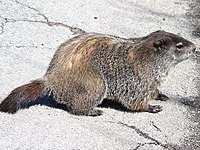
| Groundhog at Laval Academy campus, Quebec, Canada | |
| Conservation status | |
| | |
Scientific classification  | |
| Kingdom: | Animalia |
| Phylum: | Chordata |
| Class: | Mammalia |
| Order: | Rodentia |
| Family unit: | Sciuridae |
| Genus: | Marmota |
| Species: | Chiliad. monax |
| Binomial name | |
| Marmota monax (Linnaeus, 1758) | |
| Subspecies | |
| |
 | |
| Groundhog range | |
| Synonyms | |
| Mus monax Linnaeus, 1758 | |
The groundhog (Marmota monax), also known every bit a woodchuck, is a rodent of the family Sciuridae, belonging to the group of big ground squirrels known equally marmots.[2] The groundhog is a lowland beast of North America; information technology is found through much of the Eastern Usa, across Canada and into Alaska.[iii] Information technology was beginning scientifically described by Carl Linnaeus in 1758.[4]
The groundhog is also referred to equally a chuck, wood-shock, groundpig, whistlepig,[5] [6] whistler, thickwood badger, Canada marmot, monax, moonack, weenusk, red monk,[half dozen] land beaver,[vii] and, among French Canadians in eastern Canada, siffleux.[viii]
The name "thickwood badger" was given in the Northwest to distinguish the animal from the prairie badger. Monax (Móonack) is an Algonquian name of the woodchuck, which means "digger" (cf. Lenape monachgeu).[9] [10] Young groundhogs may exist called chucklings.[eleven] : 66
The groundhog, existence a lowland animal, is exceptional amid marmots. Other marmots, such every bit the yellowish-bellied and hoary marmots, live in rocky and mountainous areas. Groundhogs play an important part maintaining salubrious soil in woodland and plain areas. The groundhog is considered a crucial habitat engineer.[12] [xiii] [14] Groundhogs are considered the most alone of the marmot species. They live in aggregations, and their social organization also varies across populations. Groundhogs practice non form stable, long-term pair-bonds, and during mating flavor male-female interactions are limited to copulation. In Ohio, developed males and females acquaintance with each other throughout the year and often from twelvemonth to year.[xv] [16] Groundhogs are an extremely intelligent fauna forming complex social networks, able to understand social behavior, course kinship with their young, empathize and communicate threats through whistling, and piece of work cooperatively to solve tasks such as burrowing.[17] [eighteen]
Clarification [edit]
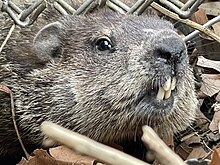
Groundhog displaying its incisors
The groundhog is by far the largest sciurid in its geographical range, excepting British Columbia where its range may abut that of its somewhat larger cousin, the hoary marmot. Adults may mensurate from 41.8 to 68.5 cm (16+ vii⁄16 to 26+ 15⁄16 in) in total length, including a tail of ix.5 to 18.7 cm (3+ 3⁄4 to 7+ 3⁄8 in).[19] [xx] [21] Weights of adult groundhogs typically autumn betwixt 2 and 6.3 kg (4 lb 7 oz and 13 lb xiv oz).[21] [22] [23]
Male groundhogs average slightly larger than females and, similar all marmots, they are considerably heavier during autumn (when engaged in autumn hyperphagia) than when emerging from hibernation in spring. Adult males average year-around weight 3.83 kg (8 lb seven oz), with spring to fall average weights of 3.one to 5.07 kg (6 lb xiii oz to eleven lb 3 oz) while females boilerplate 3.53 kg (vii lb 13 oz), with spring to autumn averages of iii.08 to 4.eight kg (6 lb 13 oz to 10 lb 9 oz).[19] [24] Seasonal weight changes signal circannual deposition and use of fatty. Groundhogs reach progressively higher weights each twelvemonth for the first two or three years, later on which weight plateaus.[19]
Groundhogs accept four incisor teeth, which abound 1.five millimetres ( 1⁄16 in) per calendar week. Constant usage wears them down over again past about that much each week.[25] Unlike the incisors of many other rodents, the incisors of groundhogs are white to ivory-white.[26] [27] Groundhogs are well-adapted for digging, with powerful, short legs and broad, long claws. The groundhog's tail is shorter than that of other sciurids—only nigh one-fourth of body length.
Etymology [edit]
The etymology of the name woodchuck is unrelated to woods or chucking. It stems from an Algonquian (perhaps Narragansett) name for the animal, wuchak.[28] The similarity between the words has led to the popular tongue-twister:[29]
- How much wood would a woodchuck chuck
- if a woodchuck could chuck wood?
- A woodchuck would chuck all the woods he could
- if a woodchuck could chuck woods!
Distribution and habitat [edit]
The groundhog prefers open up country and the edges of woodland, and is rarely far from a burrow entrance.[30] Marmota monax has a wide geographic range. It is typically found in low-pinnacle forests, small woodlots, fields, pastures and hedgerows. It constructs dens in well-drained soil, and most have summer and winter dens. Man activity has increased nutrient access and affluence, allowing M. monax to thrive.[31]
Survival [edit]

Groundhogs can climb copse to escape predators.
In the wild, groundhogs can live up to six years with two or three being average. In captivity, groundhogs reportedly live up to 14 years. Man development, which often produces openings juxtaposed with second growth trees that are incidentally likewise favored past groundhogs, often ensures that groundhogs in well-adult areas are nearly free of predators, beyond humans (through various forms of pest control or roadkills) or mid-to-large sized dogs.[32]
Wild predators of adult groundhogs in most of eastern North America include coyotes, badgers,[33] bobcats, and foxes (largely merely red fob). Many of these predators are successful stealth stalkers and then tin can catch groundhogs by surprise before the large rodents can escape to their burrows; badgers likely hunt them by digging them out from their burrows. Coyotes in item are sizable enough to overpower any groundhog, with the latter existence the third most meaning prey species per a statewide written report in Pennsylvania.[34] [35] [36] [37] [38] [39]
Large predators such as gray wolf and eastern cougar are basically extirpated in the east but yet may chase groundhogs on occasion in Canada.[xl] [41] Gilt eagles can too prey on adult groundhogs, merely seldom occur in the same range or in the same habitats as this marmot. Likewise, neat horned owls tin can reportedly, per Bent (1938), prey upon groundhogs, just this owl rarely does so, particularly given the temporal differences in their behaviors.[42] [43]
Young groundhogs (usually those less than a couple months in age) may as well be taken by an American mink, perhaps other smallish mustelids, cats, timber rattlesnakes, and hawks. Red-tailed hawks can take groundhogs at least of upwards to the size of yearling juveniles, and northern goshawks can have them up to perhaps weak emergent-adult groundhogs in the Leap.[19] [21] [44] [45] [46]
Beyond their large size, groundhogs have several successful anti-predator behaviors, usually retreating to the prophylactic of their burrow which nearly predators volition not try to enter, but also being gear up to fight off with their sharp claws and large incisors whatever who press the assault. They can also scale trees to escape a threat.[47] [48]
Occasionally, woodchucks may suffer from parasitism and a woodchuck may die from infestation or from leaner transmitted by vectors.[49] In areas of intensive agriculture and the dairying regions of the state of Wisconsin, especially in its southern parts, the woodchuck by 1950 had been near extirpated.[50] : 124 Jackson (1961) suggested that exaggerated reports of harm done by the woodchuck led to excessive alternative, substantially reducing its numbers in the land.
In some areas woodchucks are important game animals and are killed regularly for sport, food, or fur. In Kentucky, an estimated 267,500 Chiliad. monax were taken annually from 1964 to 1971 (Barbour and Davis 1974).[51] Woodchucks had protected status in the state of Wisconsin[52] until 2017.[53] Woodchuck numbers announced to have decreased in Illinois.[54]
Behavior [edit]

A motionless individual, alert to danger, will whistle when alarmed, to warn other groundhogs.
The time spent observing groundhogs past field biologists represents only a small fraction of time devoted to the field research.[55] West.J. Schoonmaker reports that groundhogs may hibernate when they meet, smell or hear the observer.[11] : 41–43 Marmot researcher Ken Armitage states that the social biology of the groundhog is poorly studied.[56] Despite their heavy-bodied appearance, groundhogs are accomplished swimmers and occasionally climb trees when escaping predators or when they want to survey their environs.[57] They prefer to retreat to their burrows when threatened; if the burrow is invaded, the groundhog tenaciously defends itself with its ii large incisors and front end claws. Groundhogs are by and large agonistic and territorial amid their own species and may skirmish to constitute dominance.[58] Outside their burrow, individuals are alarm when not actively feeding. It is common to see i or more well-nigh motionless individuals standing erect on their hind anxiety watching for danger. When alarmed, they utilise a high-pitched whistle to warn the rest of the colony, hence the name "whistle-pig".[59] [threescore] Groundhogs may squeal when fighting, seriously injured, or caught by a predator.[60] Other sounds groundhogs may make include depression barks and a sound produced by grinding their teeth.[60] David P. Barash wrote that he witnessed only two occasions of upright play-fighting amongst woodchucks and that the upright posture of play-fighting involves sustained physical contact between individuals and may require a caste of social tolerance nigh unknown in M. monax. He said it was possible to conclude, alternatively, that upright play-fighting is role of the woodchuck's behavioral repertory just rarely shown because of physical spacing and/or low social tolerance.[61]
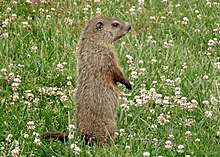
Clover is a preferred food source for groundhogs.
Diet [edit]
Mostly herbivorous, groundhogs swallow primarily wild grasses and other vegetation, including berries and agricultural crops, when available.[58] In early on leap, dandelion and coltsfoot are important groundhog food items. Some boosted foods include sheep sorrel, timothy-grass, buttercup, tearthumb, agrimony, scarlet and black raspberries, mulberries, buckwheat, plantain, wild lettuce, all varieties of clover, and alfalfa.[62] Groundhogs as well occasionally eat modest animals, such as grubs, grasshoppers, snails, and even babe birds,[63] but are not as omnivorous as many other Sciuridae.
An developed groundhog can eat more than a pound of vegetation daily.[64] In early June, woodchucks' metabolism slows, and while their food intake decreases, their weight increases past every bit much as 100% as they produce fat deposits to sustain them during hibernation and belatedly winter.[65] Instead of storing nutrient, groundhogs stuff themselves to survive the wintertime without eating.[66] Thought not to drink water, groundhogs are reported to obtain needed liquids from the juices of food-plants, aided by their sprinkling with rain or dew.[67] [68] [69]
Burrows [edit]
Groundhogs are excellent burrowers, using burrows for sleeping, rearing immature, and hibernating. W. J. Schoonmaker excavated 11 dens, finding that the volume of earth removed from these averaged half dozen cubic anxiety (0.17 thouiii) per den. The longest burrow measured 24 feet (vii.iii m) plus ii short side galleries. The volume of soil taken from this den was eight U.s.a. bushels (0.28 m3), weighing 640 pounds (290 kg). The boilerplate weight of the earth taken from all 11 dens was 384 pounds (174 kg).[70] Though groundhogs are the most solitary of the marmots, several individuals may occupy the same couch. Groundhog burrows usually have two to five entrances, providing groundhogs their master ways of escape from predators. Burrows can pose a serious threat to agronomical and residential development past damaging farm machinery and even undermining building foundations.[59] In a June 7, 2009, Humane Guild of the Usa article, "How to Humanely Chuck a Woodchuck Out of Your Thousand", John Griffin, director of Humane Wildlife Services, stated you would have to accept a lot of woodchucks working over a lot of years to create tunnel systems that would pose any risk to a construction.

Groundhog with mouthful of burrow cloth
The couch is used for safety, retreat in bad atmospheric condition, hibernating, sleeping, honey nest, and plant nursery. In addition to the nest, at that place is an excrement chamber. The hibernation or nest chamber is lined with dead leaves and dried grasses.[71] The nest chamber may exist about twenty inches to three feet below footing surface. It is about 16 inches (41 cm) wide and 14 inches (36 cm) high. At that place are typically two couch openings or holes. One is the main entrance, the other a spy pigsty. Clarification of the length of the couch often includes side galleries. Excluding side galleries, Schoonmaker reports the longest was 24 feet (7.3 k), and the average length of eleven dens was 14 anxiety (4.iii 1000).[72] W. H. Fisher investigated nine burrows, finding the deepest indicate 49 inches (120 cm) downwards. The longest, including side galleries, was 47 ft xi.5 in (fourteen.62 yard).[73] Numbers of burrows per individual groundhog decrease with urbanization.[74] [75]
Bachman mentioned that when the young groundhogs are a few months former, they prepare for separation, digging a number of holes in the area of their early on home. Some of these holes were just a few feet deep and never occupied but the numerous burrows gave the impression that groundhogs live in communities.[76]
Hibernation [edit]
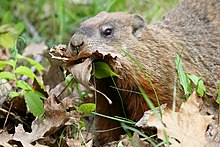
Groundhog gathering nesting material for its warm burrow
Groundhogs are i of the few species that enter into true hibernation, and oft build a separate "winter couch" for this purpose. This burrow is unremarkably in a wooded or brushy area and is dug beneath the frost line and remains at a stable temperature well above freezing during the winter months. In most areas, groundhogs hide from October to March or April, merely in more than temperate areas, they may hibernate as trivial as iii months.[77] Groundhogs hibernate longer in northern latitudes than southern latitudes.[78] [79] To survive the wintertime, they are at their maximum weight shortly before entering hibernation.[lxxx] When the groundhog enters hibernation, there is a drop in body temperature to as low every bit 35 degrees Fahrenheit, heart rate falls to 4–x beats per minute and breathing rate falls to 1 breath every six minutes.[81] During hibernation, they feel periods of torpor and arousal.[82] Hibernating woodchucks lose as much as one-half their body weight past February.[83] They sally from hibernation with some remaining body fat to live on until the warmer jump conditions produces abundant plant materials for food.[eighty] Males emerge from hibernation before females.[84] [85] Groundhogs are mostly diurnal, and are often active early in the morning or late afternoon.[86]
Reproduction [edit]

Usually groundhogs breed in their second year, but a small proportion may breed in their outset. The breeding season extends from early March to mid- or late Apr, subsequently hibernation. Woodchucks are polygynous [87] only simply alpine and woodchuck marmot females have been shown to mate with multiple males.[88] A mated pair remains in the same den throughout the 31- to 32-day gestation period.[89] As nascence of the immature approaches in April or May, the male leaves the den. I litter is produced annually. Female woodchucks give birth to one to ix offspring, with most litters ranging between 3 and 5 pups.[90] Groundhog mothers introduce their young to the wild once their fur is grown in and they can come across. At this fourth dimension, if at all, the father groundhog comes dorsum to the family.[91] : 316 By the finish of August, the family breaks up; or at least, the larger number scatter, to burrow on their ain.[92]
Relationship with humans [edit]
Both their diet and their habit of burrowing make groundhogs serious nuisance animals around farms and gardens. They will consume many unremarkably grown vegetables, and their burrows can undermine foundations.
Very often, the dens of groundhogs provide homes for other animals, including skunks, red foxes, and cottontail rabbits. The flim-flam and skunk feed upon field mice, grasshoppers, beetles and other creatures that destroy farm crops. In aiding these animals, the groundhog indirectly helps the farmer. In add-on to providing homes for itself and other animals, the groundhog aids in soil improvement by bringing subsoil to the surface. The groundhog is also a valuable game animal and is considered a difficult sport when hunted in a fair manner.[93] In some parts of the U.S., they have been eaten.[94]
A report in 1883 by the New Hampshire Legislative Woodchuck Committee describes the groundhog's objectionable graphic symbol:[95] [96]
The woodchuck, despite its deformities both of mind and body, possesses some of the civilities of a college culture. Information technology cleans its face afterwards the manner of the squirrels, and licks its fur later the way of a cat. Your committee is too wise, nevertheless, to exist deceived by this purely superficial ascertainment of better habits. Contemporaneous with the ark, the woodchuck has not made any material progress in social scientific discipline, and it is now as well late to reform the wayward sinner. The average age of the woodchuck is likewise long to please your commission.... The woodchuck is not only a nuisance, but also a bore. It burrows beneath the soil, and so chuckles to run into a mowing auto, man and all, slump into one of these holes and disappear....
The committee concludes that "a minor bounty will testify of incalculable skillful; at all events, fifty-fifty as an experiment, information technology is certainly worth trying; therefore your committee would respectfully recommend that the accompanying bill be passed."[97]
Groundhogs may be raised in captivity, simply their ambitious nature can pose problems. Doug Schwartz, a zookeeper and groundhog trainer at the Staten Island Zoo, has been quoted as saying "They're known for their aggression, so y'all're starting from a hard place. His natural impulse is to kill 'em all and let God sort 'em out. Yous have to work to produce the sweet and cuddly."[98] Groundhogs cared for in wildlife rehabilitation that survive only cannot be returned to the wild may remain with their caregivers and go educational ambassadors.[99] [100] [101]
In the U.s. and Canada, the yearly February 2 Groundhog Day celebration has given the groundhog recognition and popularity. The most popularly known of these groundhogs are Punxsutawney Phil, Wiarton Willie, Jimmy the Groundhog, Dunkirk Dave, and Staten Isle Chuck kept every bit part of Groundhog Day festivities in Punxsutawney, Pennsylvania; Wiarton, Ontario; Dominicus Prairie, Wisconsin; Dunkirk, New York; and Staten Isle respectively. The 1993 comedy movie Groundhog Solar day references several events related to Groundhog Day, and portrays both Punxsutawney Phil himself, and the annual Groundhog Mean solar day ceremony. Famous Southern groundhogs include General Beauregard Lee, based at the Dauset Trails Nature Center outside Atlanta, Georgia.[102]
Groundhogs are used in medical research on hepatitis B-induced liver cancer. A percentage of the woodchuck population is infected with the woodchuck hepatitis virus (WHV), like to human hepatitis B virus. Humans exercise not receive hepatitis from woodchucks with WHV, but the virus and its furnishings on the liver make the woodchuck the best available animal for the written report of viral hepatitis in humans. The only other animate being model for hepatitis B virus studies is the chimpanzee, an endangered species.[103] Woodchucks are also used in biomedical research investigating metabolic office, obesity, energy balance, the endocrine system, reproduction, neurology, cardiovascular affliction, cerebrovascular disease, and neoplastic illness.[104] Researching the hibernation patterns of groundhogs may lead to benefits for humans, including lowering of the heart rate in complicated surgical procedures.[105]
Groundhog burrows take revealed at to the lowest degree two archaeological sites, the Ufferman Site in the U.Southward. state of Ohio[106] and Meadowcroft Rockshelter in Pennsylvania. Archaeologists take never excavated the Ufferman Site, but the activities of local groundhogs have revealed numerous artifacts. They favor the loose soil of the esker at the site lies, and their burrow digging has brought many objects to the surface: human and animal basic, pottery, and bits of stone.[106] Woodchuck remains were establish in the Indian mounds at Aztalan, Jefferson County, Wisconsin.[107]
Robert Frost's verse form "A Drumlin Woodchuck" uses the imagery of a groundhog dug into a minor ridge as a metaphor for his emotional reticence.[108]
-
Shut come across with man lensman at Sheldon Marsh State Nature Preserve, Ohio
References [edit]
- ^ Cassola, F. (2017) [errata version of 2016 assessment]. "Marmota monax". IUCN Cherry-red Listing of Threatened Species. 2016: e.T42458A115189992. doi:10.2305/IUCN.UK.2016-3.RLTS.T42458A22257685.en . Retrieved Feb 19, 2022.
- ^ Thorington, R.W., Jr.; Hoffman, R.S. (2005). "Family Sciuridae". In Wilson, D.E.; Reeder, D.M (eds.). Mammal Species of the World: A Taxonomic and Geographic Reference (tertiary ed.). Johns Hopkins Academy Press. p. 802. ISBN978-0-8018-8221-0. OCLC 62265494.
- ^ "Marmota monax, Woodchuck". North American Mammals. Smithsonian National Museum of Natural History.
- ^ Linné, Carl von (1758). Systema naturae per regna tria naturae. Vol. i (10 ed.). Impensis Direct. Laurentii Salvii. p. 60 – via Biodiversity Heritage Library.
- ^ "Marmota monax". North American Mammals. Smithsonian Establishment. Retrieved February 1, 2015.
- ^ a b Seton, Ernest Thompson. Lives of Game Animals. Vol. 4. p. 300.
- ^ Keck, Nina. "Where Do The Terms 'Woodchuck' And 'Flatlander' Come up From?". www.vpr.org . Retrieved Feb two, 2021.
- ^ Canadian Wild fauna Federation - Faune et flore du pays - La marmotte district
- ^ Chamberlain, Alexander F. (Nov 22, 2018). "Algonkian Words in American English: A Study in the Contact of the White Homo and the Indian". The Periodical of American Sociology. 15 (59): 240–267. doi:10.2307/533199. JSTOR 533199.
- ^ Seton, Ernest Thompson, Lives of Game Animals. pp. 300–301
- ^ a b Schoonmaker, West.J. (1966). The Earth of the Woodchuck. J.B. Lippincott. ISBN978-1135544836.
- ^ Meier, Paul T. (Dec one, 1992). "Social organization of woodchucks (Marmota monax)". Behavioral Environmental and Sociobiology. 31 (half-dozen): 393–400. doi:10.1007/BF00170606. S2CID 44244749 – via Springer Link.
- ^ Pustilnik, Jeremy D.; Searle, Jeremy B.; Curtis, Paul D. (2021). "The effects of crimson play a trick on scent on winter activity patterns of suburban wildlife: evaluating predator-prey interactions and the importance of groundhog burrows in promoting biodiversity". Urban Ecosystems. 24 (three): 529–547. doi:ten.1007/s11252-020-01056-5 – via Springer Link.
- ^ Moore, Alexis Lee; Butcher, Michael (May 18, 2011). "Functional specialization in the forelimbs of two digging mammals: the American badger (Taxidea taxus) and groundhog (Marmota monax)". The FASEB Periodical. 25 (S1): 867.12. doi:ten.1096/fasebj.25.1_supplement.867.12 – via Wiley Online Library.
- ^ Christine R. Maher, Melissa Duron, Mating system and paternity in woodchucks (Marmota monax) Journal of Mammalogy, Volume 91, Issue 3, June 16, 2010, Pages 628-635, https://doi.org/10.1644/09-MAMM-A-324.1
- ^ Gary G. Kwiencinski, Marmota monax, Mammalian Species, Upshot 591, December 4, 1998, Pages 1-8, https://doi.org/ten.2307/3504364
- ^ Maher, Christine R. (2009). "Genetic Relatedness and Infinite Utilize in a Behaviorally Flexible Species of Marmot, the Woodchuck (Marmota monax)" (PDF). Behavioral Ecology and Sociobiology. 63 (6): 857–868. doi:10.1007/s00265-009-0726-5. JSTOR 40295409. S2CID 20892108.
- ^ A test of the acoustic adaptation hypothesis in 4 speciesof marmots, by JANICE C. DANIEL & DANIEL T. BLUMSTEIN, Department of Systematics and Environmental, University of Kansas. Published by The Association for the Study of Beast Behaviour
- ^ a b c d Kwiecinski, One thousand. Yard. (1998). Marmota monax. Mammalian Species, (591), one-viii.
- ^ Schwartz, C. West., & Schwartz, E. R. (2001). The wild mammals of Missouri. University of Missouri Press.
- ^ a b c Wildlife of Virginia and Maryland and Washington, D.C. 2003, Charles Fergus, p. 45, ISBN 978-0811728218
- ^ Ferron, J., & Ouellet, J. P. (1991). Physical and behavioral postnatal development of woodchucks (Marmota monax). Canadian Periodical of Zoology, 69(four), 1040-1047.
- ^ Couser, W., Sargent, P., Brownhill, 50. Due east., & Benirschke, M. (1963). The somatic chromosomes of the Northeastern American woodchuck, Marmota monax. Cytologia, 28(1), 108-111.
- ^ Due north Carolina Wild, Wildlife Profiles, Woodchuck, Marmota monax
- ^ Leon Yard. Lederman Scientific discipline Teaching Center. "Woodchuck". Fermilab Flora and Fauna Virtual Showroom.
- ^ Ohio DNR, ODNR Division of WILDLIFE, Woodchuck (Groundhog) -Marmota monax
- ^ Schoonmaker, W.J.,(1966) The World of the Woodchuck, p. twenty
- ^ Marmota monax: Woodchuck. animaldiversity.com. Retrieved on Feb 24, 2015.
- ^ Lyrics and Words for Children's Nursery Rhymes and Songs. BusSongs.com. Retrieved on September 15, 2011.
- ^ Grizzell, Roy A. (Apr 1955). "A Written report of the Southern Woodchuck, Marmota monax monax". American Midland Naturalist. 53 (2): 257–293. doi:x.2307/2422068. JSTOR 2422068.
- ^ "Marmota monax (woodchuck)". Animal Variety Web.
- ^ Lehrer, East. Due west., Schooley, R. L., & Whittington, J. K. (2011). "Survival and antipredator behavior of woodchucks (Marmota monax) along an urban–agricultural slope". Canadian Periodical of Zoology, 90(1), 12-21.
- ^ "Badger Biology (Ontario Badgers)". www.ontariobadgers.org . Retrieved July 22, 2019.
- ^ Witmer, G. Due west., Pipas, Thousand. J., & Hayden, A. (1995). "Some observations on coyote food habits in Pennsylvania". Journal of the Pennsylvania University of Science, 69(2):77-80.
- ^ Gipson, P. S. (1974). "Food habits of coyotes in Arkansas". The Journal of Wildlife Management, 38(4):848-853.
- ^ Progulske, D. R. (1955). "Game animals utilized equally food past the bobcat in the southern Appalachians". The Journal of Wildlife Direction, 19(ii), 249-253.
- ^ Rose, C., & Prange, S. (2015). "Diet of the recovering Ohio bobcat (Lynx rufus) with a consideration of 2 subpopulations". The American Midland Naturalist, 173(2), 305-318.
- ^ Hockman, J. G., & Chapman, J. A. (1983). "Comparative feeding habits of cerise foxes (Vulpes vulpes) and grayness foxes (Urocyon cinereoargenteus) in Maryland". American Midland Naturalist, 276-285.
- ^ Wildlife of Pennsylvania, Charles Fergus, Amelia Hansen, p. 43, ISBN 978-0811728997
- ^ Voigt, D. R., Kolenosky, G. B., & Pimlott, D. H. (1976). "Changes in summer foods of wolves in fundamental Ontario". The Journal of Wildlife Management, 40(4):663-668.
- ^ Bolgiano, C., & Roberts, J. (Eds.). (2005).The Eastern Cougar: Celebrated Accounts, Scientific Investigations, and New Evidence. Stackpole Books.
- ^ Olendorff, R. R. (1976). The food habits of North American gilt eagles. American Midland Naturalist, 231-236.
- ^ Bent, A. C. 1938. Life histories of North American birds of prey, Role ii. U.S. National Museum Bulletin 170:295-357.
- ^ Becker, T. Due east.; Smith, D. 1000.; Bosakowski, T. (2006). "Habitat, food habits, and productivity of northern goshawks nesting in Connecticut". Studies in Avian Biology. 31: 119–125.
- ^ Aschemeier, L. Yard., & Maher, C. R. (2011). "Eavesdropping of woodchucks (Marmota monax) and eastern chipmunks (Tamias striatus) on heterospecific alarm calls". Journal of Mammalogy. 92 (3): 493–499. doi:10.1644/09-MAMM-A-322.one.
{{cite periodical}}: CS1 maint: multiple names: authors listing (link) - ^ George, W. M. (1974). "Domestic cats every bit predators and factors in winter shortages of raptor casualty". The Wilson Message, 384-396.
- ^ Beer, Amy-Jane & Morris, Pat (2004). Encyclopedia of North American Mammals: An Essential Guide to Mammals of North America. Thunder Bay Printing, ISBN 978-1-59223-191-1.
- ^ Watson, E. L. (2010). Effects of urbanization on survival rates, anti-predator behavior, and movements of woodchucks (Marmota monax). University of Illinois.
- ^ The Wild Mammals of Wisconsin, Charles A. Long, p 162, ISBN 978-9546423139
- ^ Jackson, Hartley H T (1961). Mammals of Wisconsin. University of Wisconsin Press.
- ^ Walker'south Mammals of the World, Vol. ane, 1991. page 569.
- ^ "Wisconsin's endangered and threatened species laws". Wisconsin Department of Natural Resources. Retrieved April 25, 2018.
- ^ "Wisconsin Gov. Walker signs woodchuck hunting bill" Chicago Tribune, November 13, 2017.
- ^ Groundhog-Illinois DNR, OutdoorIllinois, July 2008, "The Beast That Keeps Digging", Kari Thornton, p.20.
- ^ Barash, David (1989) Marmots, Social Beliefs and Biology. Stanford University Printing. Preface p. fifteen. ISBN 0804715343.
- ^ Special feature "The Study of Groundhogs: A Real Life Look at Marmots", Movie "Groundhog Day" 15th Anniversary Edition.
- ^ Chapman, J. A.; Feldhammer, G. A. (1982). Wild Mammals of Due north America, Biology, Direction, Economics . Johns Hopkins University Press. ISBN0801823536.
- ^ a b Whitaker, John O; Hamilton, W J. (1998). Mammals of the Eastern Us . Cornell University Press. ISBN0-8014-3475-0.
- ^ a b Light, Jessica E. "Animate being Diversity Spider web: Marmota monax". University of Michigan Museum of Zoology. Retrieved July 14, 2009.
- ^ a b c Hinterland Who's Who ("Canadian Wildlife Service: Mammals: Woodchuck"). Hww.ca. Retrieved on September 15, 2011.
- ^ Marmots, Social Beliefs and Biological science, 1989, David P. Barash, Stanford University Press, p. 97.
- ^ Schoonmaker, W. J. (1966) The Earth of the Woodchuck, p. 93
- ^ Canadian Wildlife Federation, Groundhog
- ^ DNR, Indiana Department of Natural Resource, Groundhog
- ^ Woodchucks Are in the Lab, just Their Body Clocks Are Wild, The New York Times, Les Line, January 29, 1997
- ^ Discovery Nature Encyclopedia, Groundhog
- ^ Schoonmaker, W. J. (1966) The Globe of the Woodchuck, p. 85
- ^ The Virtual Nature Trail at Penn State New Kensington Species Pages Scientific proper name: Marmota monax Common name: woodchuck
- ^ Seton, Ernest Thompson, Lives of Game Animals, Volume 4, p. 308
- ^ Schoonmaker, W. J., The World of the Woodchuck p. 108-109
- ^ Kwiecinski, One thousand. (1998). Marmota monax. Mammalian Species, (591) pg 6 doi:10.2307/3504364
- ^ Schoonmaker, W. J., The Globe of the Woodchuck, p. 104-105
- ^ Seton, Ernest Thompson, Lives of Game Animals, p. 306
- ^ Effects of Urbanization on Survival Rates, Anti-Predator Behavior, and Movements of Woodchucks (Marmota monax), Elizabeth L. Watson
- ^ Canadian Journal of Zoology, 2012, Vol 90(i):12–21 Survival and antipredator beliefs of woodchucks (Marmota monax) forth an urban-agricultural gradient, E. W. Lehrer, R. L. Schooley, J. K. Whittington
- ^ Seton, Ernest Thompson, Lives of Game Animals, p. 318
- ^ Woodchucks in Rhode Island Archived Apr 12, 2007, at the Wayback Machine. (PDF) dem.ri.gov. Retrieved on September xv, 2011.
- ^ Latitudinal Differences in the Hibernation Characteristics of Woodchucks (Marmota monax), Physiological and Biochemical Zoology: Ecological and Evolutionary Approaches, Vol. 83, No. 1, pp. 135–141, Stam M. Zervanos, Christine R. Maher, Jerry A. Waldvogel and Gregory 50. Florant
- ^ "Professor sheds low-cal on groundhog'southward shadowy beliefs". berks.psu.edu. Jan 23, 2014.
- ^ a b Woodchucks in Rhode Island, dem.ri.gov
- ^ "Request Rejected | UWSP".
- ^ Penn State news, January 22, 2014, Professor sheds calorie-free on groundhog'southward shadowy behavior
- ^ Groundhog Day facts and factoids, Cornell Relate, February 1, 1996
- ^ Kwiecinski, Gary G. (1998). "Marmota monax". Mammalian Species (591): i–viii. doi:ten.2307/3504364. JSTOR 3504364.
- ^ Schoonmaker, W.J. (1966) The Earth of the Woodchuck p.50
- ^ Woodchuck Archived April 21, 2014, at the Wayback Motorcar, Illinois University
- ^ ADW:Marmota monax woodchuck
- ^ Christine R. Maher, Melissa Duron, "Mating arrangement and paternity in woodchucks (Marmota monax)", Periodical of Mammalogy, Volume 91, Issue 3, June sixteen, 2010, pp. 628-635
- ^ Woodchuck. Marmota monax. (PDF). North Caroline Wild fauna.
- ^ ADW:Marmot monax woodchuck
- ^ Seton, Ernest Thompson, Lives of Game Animals, Volume Four. Doubleday, Doran & Visitor.
- ^ Seton, Ernest Thompson, Lives of Game Animals, Book IV, p. 318.
- ^ Schoonmaker, W.J., The World of the Woodchuck, 1966, pp. 129–131
- ^ Castro, Everett J. (Jan 1984). "Celebrate Groundhog Day With Groundhog Recipes". Mother Earth News.
- ^ Seton, Ernest Thompson, Lives of Game Animals, p. 328
- ^ Corning, Charles R. (June 1883). "Written report of the Woodchuck Committee". Journals of the Honorable Senate and House of Representatives of the State of New Hampshire. 1883: 1193–1197. Retrieved July 4, 2021.
- ^ Schoonmaker, W.J., The World of the Woodchuck, 1966, p. 133
- ^ Newman, Andy (December i, 2007). "Grooming a Weatherman for his TV Debut, and Hoping He Doesn't Bite The Host". The New York Times.
- ^ "Sean Kirst: For Dunkirk Dave's caretaker, every 24-hour interval is Groundhog Twenty-four hour period". The Buffalo News. February 1, 2018.
- ^ The Winchester Star, Christopher Early, "Library holds Groundhog Day commemoration", p. 1A, Feb half-dozen, 2017
- ^ Winchester Star, Centerpiece, "Local groundhog predicts half dozen more weeks of winter", February ii, 2018, Cathy Kuehner
- ^ Elder, Lane (Feb 2, 2020). "Groundhog Day is steeped in tradition merely isn't the most authentic, according to conditions almanacs". The Atlanta Periodical-Constitution . Retrieved April 11, 2020.
- ^ Segelken, Roger (February ane, 1966). "At Cornell, groundhog is harbinger of health". CornellChronicle.
- ^ "Marmota monax (woodchuck)". Animal Diversity Web.
- ^ Penn State News, (Jan 29, 2009) "Professor studies groundhog hibernation to do good mankind"
- ^ a b Owen, Lorrie K. (ed.) (1999). Dictionary of Ohio Historic Places. Vol. 1. St. Clair Shores: Somerset, p. 328.
- ^ Mammals of Wisconsin, 1961, p. 124
- ^ Oehlschlaeger, Fritz (December 1982). "Two Woodchucks, or Frost and Thoreau on the Art of the Burrow". Colby Quarterly. eighteen (4): 214–219. Retrieved April ane, 2019.
Further reading [edit]
- Bezuidenhout, A. J.; Evans, Howard Eastward. (2005). Beefcake of the woodchuck (Marmota monax). Lawrence, KS: American Guild of Mammalogists. doi:10.5962/bhl.title.61270. ISBN9781891276439.
External links [edit]
- Woodchuck, Hinterland Who's Who
- Woodchuck (Groundhog), Missouri Conservation Commission
- NIH Guide: BREEDING AND EXPERIMENTAL FACILITY FOR WOODCHUCKS (MARMOTA MONAX) Convenance and Experimental Facility for Woodchucks
Source: https://en.wikipedia.org/wiki/Groundhog
0 Response to "Sweet 8lb 6oz Baby Jesus That a Lot of Drones"
Post a Comment